Tuesday, June 25, 2013

Day 7 on Attu, Back to Gilbert Ridge, June 4

Yesterday evening after enjoying the Bar-tailed Godwits, we attended the dedication of some new plaques for the 70th anniversary of the Battle of Attu.  These were installed along the road to Henderson Marsh, closer to the shore of Massacre Bay, where visitors are more likely to visit them rather than the three mile hike (feels like more) up hill to the original Japanese Memorial dedicated in 1987.  The placement of the original Japanese Memorial was at the request of Japan to be at the exact location of the final defeat of Japanese forces on Attu by US forces. 

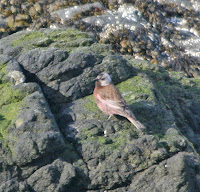
Today, June 4, I joined Jess leading Nancy, Bill, Thor, Jill and Doug to Gilbert Ridge.  The Puk-uk moved us to Massacre Beach to start the day. There were four potential birds that had been previously seen for me to add to the year list by going back to this area:   Pacific Loon, Yellow-billed Loon, McKay's Bunting and Emperor Goose.  John stayed around Casco Cove and the runways to see what he could find, but found nothing new and interesting.  Isaac went up the Peaceful river Valley and had five (5) singing Siberian Rubythroats.  Initially in the morning there was excitement on the Puk-uk.  As we pulled in to anchor along Massacre Beach, an adult breeding plumage Black-headed gull flew by and landed at some distance on the far beach.  I kept watching it, and where it landed.  Most people got good distant scope views of the Black-headed Gull, which was not a new bird for me, having seen a winter plumage bird in a mall parking lot in Baltimore, MD, but it was great to see this gull in breeding plumage.  Beautiful bird!  We found noting new on Gilbert  Ridge until Jill walked out ahead of us, close to the spot where the Dark-sided Flycatcher and Common Cuckoo appeared, and saw a shorebird like a Spotted Sandpiper.  We spread out looking and Thor first picked it up again and pointed out where the bird had landed.  I was the fist to spot it perched on a rock, but was surprised at the very brown color thinking that it might be a thrush.  However, Doug correctly pointed out that breeding plumage Common Sandpiper was brown on the back.  I saw the fine streaking on the upper breast in the shape of a thumb print, shaped like a similar mark on winter plumage Spotted Sandpiper.  Common Sandpiper is an Asian species often seen in the spring in the western Aleutians, a new bird for the year for me and a great bird for the trip.  I believe that my first sighting of this species was in Alaska on Gambell in 1976 and the bird was not completely in breeding plumage, thus my confusion on the very brown color in breeding plumage.  If my memory is correct, this is the first time that I have seen this species in breeding plumage in North America.  Everyone congratulated Jill on great spotting. 

A lot of time in the previous days has been devoted to botanizing, photographing flowers in bloom and attempting to identify them.  There was a lot of discussion and pleasant debate about the purple flowers thought to be a primula, primrose family.  Doug Gill, a biologist with botanical expertise, was the primary advocate of this identification being incorrect.  However, others from Alaska, Nancy Moore as well as a Jill and a Wildlife Biologist, who attended the new memorial dedication thought is was a primrose.   I recalled that Nobel Proctor, Biology Professor at U of Connecticut and an expert on the plants of Attu had told me that these purple flower were primula (primrose).  Now that I am home I verified this in my field notes.  Later I will summarize my photos with tentative identifications, because this blooming flowers were part of the beauty of Attu.

While we were waiting at Alexai Beach for the Puk-uk to pick us up, Jess found a Pacific Loon in the bay, another new bird for me for the year.   I got great views in the scope and could see again the differences between Arctic and Pacific Loons.  The first time I experienced this difference was on Adak in 2005. 

Below I include some alcid photos that I obtained during the trips to reposition the Puk-uk over the past few days.  The winter plumage  Kittlitz's Murrelet is very white, with a large-headed and small billed appearance with a dark crown, white face and isolated eye.  The breeding plumage or almost completely in breeding plumage Kittlitz's Murrelets are a golden or tan color with the eye still isolated on the face and with white under-tail coverts.  The second photo of Kittlitz's Murrelet shows the white outer tail feathers, which are usually hard to see.  

Common Sandpiper and Pacific Loon raise my year total to 498.


Tufted Puffin
Horned Puffin
Ancient Murrelet
Kittlitz's Murrelets, in or almost in breeding plumage
Kittlitz's Murrelet, breeding plumage

Kittlitz's Murrelet, winter plumage


Day 6 on Attu to Henderson Marsh for a Snipe Hunt, June 3

We started from Casco Cove and stopped along the runway to see both Snowy Owls.  Then Isaac led a group of us to Henderson Marsh to look for the Common Snipe.  Jess was doing some scouting and joined us later at Henderson Marsh.  John split off on the road to Henderson Marsh and led a group up Engineer Hill to the Japanese Memorial hoping that up high in the foot hills there might be a chance for Rock Ptarmigan, which we were still missing.  Isaac, Thor, Nancy, Jim and I searched the south side of Henderson Marsh, walking in a line back and forth across the marsh but found no snipe.  We found Eurasian Green-winged Teal, which were everywhere on Attu, Cackling Geese and Mallards but no snipe.  Jess called us on the walkie talkie, came to Henderson Marsh and walked along a line of posts north of the bridge where he heard a snipe giving its ground call.  After lunch we all searched north of the bridge across the river, in the location where Jess heard the ground call, but no luck.  In the proverbial snipe hunt, we were left holding the bag.  We hiked up to the barrel dump and found Gray-crowned Rosy-Finch again and Hoary Redpoll.  I saw the male and female Hoary Redpolls copulating in the willows.  We returned to the area near Brambling Bluff, and walked out the road toward the point near Loaf Island.  It was cloudy misty and very dim.  Isaac had walked out the beach while the rest of us were on the gravel road.  He found three Bar-tailed Godwits, a new bird for the year for me as well as for the trip, and again preserved my record of a new bird for each day of this trip with a late day showing.  John and his group were back from the Japanese Memorial and were near the end of the runway, but all arrived on time to see the godwits.   It was so dim I barely was able to get any photos. 
Bar-tailed Godwits
The godwits took off and flew and then returned to the beach.  During their flight I saw the barred tails; thus, the name.  Thor and I stayed and tried for better photos.  My photos were acquired in very low light and adjusted significantly in Adobe Photoshop.

Bar-tailed Godwit raises the total to 496.


Monday, June 24, 2013

Day 5 on Attu, Back to Gilbert Ridge via Alexai, June 2


We went back to Gilbert Ridge by landing at Alexai Beach first.   We checked Smew pond but the Smew seemed to be missing.   The whole group walked the beach starting on the north and walking around the point.  We were hoping to find more shorebirds, but it was probably too late in the year.  The shorebird migration usually occurs earlier.  So far, we found mostly Asian, migrant passerine (small land bird) species and only a few shorebirds, but were missing Asian shorebird rarities, like Red-necked Stint, Little Stint and Long-toed Stint.  We found a Ruddy Turnstone on the rocks on the way the way to the point, which was a bit of a surprise.  Isaac Helmericks found a Whimbrel (variagatus), an Asian sub-species of the North American Whimbrel with a white streaked rump, not a new bird for the year for me, a sub-species but nice to see.  The Whimbrel was not a very cooperative bird and seemed to disappear in the rocks along the peninsular.  Jess took a group to Henderson Marsh via Brambling Bluff.  The Puk-uk took them to the vicinity of Massacre Beach to save time, while the rest of us with John Puschock and Isaac Helmericks hiked Gilbert Ridge toward Massacre Beach.  We walked up on the low bluff on Alexai and flushed the Whimbrel.  John and Isaac contacted Jess's group and they came back and joined us so their group could also see the Whimbrel.  Isaac found the Wood Sandpiper again in the same pond.  We returned to Smew Pond and found the two Smew again, and then continued to hike Gilbert Ridge toward Massacre Beach.  Jess contacted us by radio.  He found a McKay's Bunting briefly by the first pier from Massacre Beach, but if flew off and disappeared, after singing in the area near a male and female Snow Bunting.  McKay's Bunting would be a new bird for the year for me.  We had another Yellow Wagtail that John picked up as it flew by the first part of the group and then landed near the beach for the latter part of the group.  John also had a brief view of an Emperor Goose that flew toward Massacre Beach.  He was the only one in the group to see it.  Emperor Goose is a bird that I need for the year.   Jess also reported a Pacific Loon (a new bird for me) near the first pier, and a snipe presumed to be a Common Snipe (also a new bird for me) in Henderson Marsh, that Nancy and Jill kicked up along the trail.  Jess heard it giving its ground call.  Things were happening but not for me.  When we arrived at Massacre Beach, we walked to the first pier to look for the McKay's Bunting, but did not find it.  Jess and his group were there.  Jill said there was a loon in the bay near the pier with white patches on the sides.  Everyone reacted, because that's a field marks for an Arctic Loon!  We found it, and it was indeed an Arctic Loon, a new bird for the year for me, and a late day addition to preserve my record of getting at least one new bird for the year every day of this trip.  See photo showing the white "wheel well" along the flanks and the bolder black and shite stripes on the neck than Pacific Loon.
Arctic Loon
We stayed there for a while enjoying the Arctic Loon in breeding plumage, a really rare bird for most of North America, that is more common in Asia and Europe.  Gradually the group was being transferred to the Puk-uk now anchored near Massacre Beach.  See photo showing the outrigger returning to the Puk-uk.  Just before the last group left for the Puk-uk, the male and female Snow Bunting appeared but there was no McKay's Bunting to be seen.  Scenery photos below.

Arctic Loon raises the total to 495.


Gilbert Ridge from Alexai
Into the Mist to Gilbert Ridge from Alexai

 
Waterfall, Gilbert Ridge


Waterfall, Gilbert Ridge


Waterfall, Gilbert Ridge
Jay at Waterfall
Back to the Puk-uk


Day 4 on Attu, June 1

John Puschock woke me at about 5:00 or 5:30 am to see a Slaty-backed gull on Casco Cove toward Murder Point.  He had the scope set up.  I saw the uniform dark gray/blackish back and wings to the wing tips.  It was uniformly darker on the mantle and wings than the Glaucous-winged Gulls.  Slaty-backed Gull is a new bird for the year.  A Slaty-backed Gull had been seen early in the morning on Casco Cove during the previous one week trip to Attu.  John alerted others in the boat, but by the time he returned, the Slaty-backed Gull had started flying around and disappeared, I thought to the other side of Murder Point.  When the rest of the gulls, mostly Glaucous-winged started to fly away, John picked up a Vega Gull and thought that he had been mistaken, but I assured him that the Slaty-backed had already disappeared; therefore, both Slaty-backed and Vega Gulls were present that morning.  It was helpful to have looked carefully at the Vega Gull that joined us briefly in the oil slick on the way to Attu, when the adult Short-tailed Albatross showed up, as discussed previously.   Vega Gull has distinctly black wing tips and gray wings that are not as dark as the wings of Slaty-backed Gull.  Soon thereafter, two Kittlitz's Murrelets appeared almost in the same location as the gulls, another new bird for the year.  Almost everyone got good looks in the scope of these large-headed, small billed and small murrelets that at this time of year are still very white.  Marbled Murrelets have a different head shape and are less white.  After breakfast, we went ashore, got our bikes and headed to Murder Point and South Beach.  We intended to try for Rock Ptarmigan at Blue Robin Canyon off of South Beach near Pseudo Krasne Point.  We picked up our bikes, and headed to Murder Point.  At Murder Point, Isaac found some Marbled and Ancient Murrelets, but I could  never get on them.  Jess found saw a relatively close Red-faced Cormorant.  See photo.
Red-faced Cormorant
At South Beach, Isaac Helmericks found Marbled Murrelets and additional Kittlitz's Murrelets in the bay for a good comparison.   Marbled Murrelets have longer bills and flatter, narrower heads than Kittlitz's Murrelets.  In addition, these Marbled Murrelets were very brown almost in breeding plumage.  Later Isaac also found a large flock of Ancient Murrelets.  Both Marbled and Ancient Murrelets are new year birds.  We had lunch on the old road along South Beach now almost gone and overgrown .

Isaac hiked up Blue Robin Canyon to look for Rock Ptarmigan, but did not find any.  There would be a continuing search for Rock Ptarmigan throughout the trip.  When we arrived back at the old Attour Base, a number of people went back to the boat, but Thor and I and a few others joined John Puschock and Isaac Helmericks to bird along Casco Cove and the runways before dinner.  Near the end of the east west runway and the mouth of the Peaceful River, we started hearing calls overhead that were Aleutian Terns.   There was a flock of about 12, and several came low enough out of the mist and clouds that we saw the white forehead, the gray under-parts on the body and the black secondary bar on the under-wings.   The calls are reminiscent of House Sparrows chirping.  Then Isaac picked up two Pacific Golden-plovers flying over the runway.  We saw the incomplete black under-parts with white under-tail coverts and heard the call that is different than American Golden-plover.  We heard other terns calling, that John and Isaac thought were Arctic terns, but the possibility for Common Tern (longipennis), the Asiatic race, made them less sure.  However, now that I am back from Anchorage and have heard Arctic Terns recently, I believe that we heard Arctic Terns.  However, I waited to count Arctic Tern until I saw and heard them in Anchorage.

Slaty-backed Gull, Kittlitz's Murrelet, Marbled Murrelet, Ancient Murrelet, Aleutian Tern and Pacific Golden-plover raise the Big year total to 494.          

May 31, Third Day Fallout, Gilbert Ridge and Alexai,

Massacre Beach and Puk-uk from Gilbert Ridge
The Puk-uk took us to Massacre Beach to bird Gilbert Ridge out to Alexai Point.  This saved miles of biking to get to this point.  I recall that it was about 12 miles to the tip of Alexai Point from Base Camp when I was on Attu before.  It was 4 to 6 miles from Massacre Beach to Alexai Point.  John Puschock alerted me to look for Marbled and Kittlitz's Murrelets on the way to Massacre Beach in the morning.  I was outside looking on the way and saw two dark small acids flying away but did not get good enough looks for a positive identification.

We walked Gilbert Ridge and right away Jess found a male and female Brambling soon after the start.  We followed them for awhile as they flew toward Alexai and up into the cliffs of Gilbert Ridge.  We found more Bramblings during the morning and the rest of the day.  Gray-crowned Rosy-finches showed up on the rocks along Gilbert Ridge just as Jess said they would.  We got excellent close looks at the rosy finches as the feed on the rocks.  See photo. 
Gray-crowned rosy-finch
John pursuing Brambling up Gilbert Ridge
We also found several Siberian Rubythroats, one a female.  Jess saw a bunting up high on the ridge and heard it call.  His description sounded like a Rustic Bunting, which I had first heard on Gambell on Saint Lawrence Island back in 1976 during my first trip to Alaska with Bird Bonanza's.  Jess got a long distant photograph of the bird from below.  It sure looked like a Rustic Bunting.  At some point John Puschock climbed the ridge to try to flush either a Brambling down into view, going well beyond for the group, which was certainly appreciated.  See photo.  As we moved out further out Gilbert Ridge, a very long-tailed wagtail flushed in front of John and the group in front.  John thought is was a Gray Wagtail, based on tail length, much longer tail in proportion to body length than Yellow Wagtail and the two-noted flight call.  Thor saw yellow on the upper parts as it flew.  Gray wagtail has a yellow rump.  It flew back over the group and gave several two-noted flight call notes as it flew over Jess and me.  Jess and I watched it disappear and go down.  Yellow Wagtail has a distinctive and loud "tsweep" single note flight call and is short-tailed relative to the body length.  It was not a White Wagtail, which would have been obvious with the bold gray and white or black and white patterns as we saw this wagtail fly back toward Massacre Beach.  We looked for it and could not find it.  Later in the day and in the week after we had seen Yellow Wagtail several times, it became apparent that it was a Gray Wagtail.  We continued out Gilbert Ridge and saw additional or the same buntings and chased this bunting for a while until most people got a satisfactory look.  My first looks were of a very rusty looking bunting and eventually saw the bird very well sitting on a ledge on the cliff.  Jess got a good photo of the Rustic Bunting at this spot.  See photo. 
Rustic Bunting
We continued further and stopped for lunch at a spot with a ladder, which I jokingly named the Stairway to Heaven.  It had been slow going because there were so many birds to see, chase and get good looks for the whole group.  Little did we realize that it would get even better.  See group photo at lunch.  Gilbert Ridge is a good vantage point for Attu scenery.  See photos at the end of this post.

At lunch I noticed a large loon offshore and called attention to it.  Jess looked at it and called it a Yellow-billed Loon.  I got on the scope but it dove and disappeared before I could see it in the scope.  I did not count it as a new species for the year.  However, now that I am home, I found a photograph that I took of some small alcids along Gilbert Ridge that has an apparent Yellow-throated Loon in it.  I was not aware of this photo while on the trip.  One photo is sharp enough that the profile looks like an identifiable Yellow-billed Loon.  Yellow-billed Loon was seen nearby in Massacre Bay by the one week trip prior to our trip.  I will solicit opinions from our trip leaders and let you know the outcome in later postings.  At some point, Jim Brown, an MD who works with Olaf Danielson, found a another Brambling, which was very cooperative to photos.  See photos.

Brambling by jay
Brambling by Jess


Incidentally, Olaf Danielson runs a business that provides emergency room doctors to hospitals.  I told Olaf that as a nude Big Year birder and an MD, he is an unconventional man in a very conventional business....but that is not news to him.  He apparently revels in that role.  Kudus to Olaf!

After lunch, we continued along Gilbert Ridge toward Alexai.  Jess found a small flycatcher, which was a Dark-sided Flycatcher, a Life Bird for me.  We first thought that it might be a Gray-streaked Flycatcher, but later developments and good photos proved that is was a Dark-sided Flycatcher.  The bird was streaked but the streaking was smudged on the sides giving it a vested look somewhat like an Olive-sided Flycatcher.  The primary extension was long but later when we looked at photos at the end of the day, not too long.  We consulted the National Geographic Guide and Birds of East Asia by Mark Brazil.  There is some lack of clarity between pictures and text, but we got it sorted out.  See my photos of Dark-sided Flycatcher showing a less distinct loral spot and slightly shorter primary extension than the Gray-streaked Flycatcher.   Compare to later photograph.


Dark-sided Flycatcher both by Jay

Common Cuckoo both by Jess
Shortly, John found a bird sitting on the path, which was a Common Cuckoo, another Life Bird for me.  See Jess's photos sitting and in flight which are better than mine.  We continued with the Common Cuckoo to the base of Alexai.   Jess flushed a sandpiper from one of the ponds on Alexai as we headed toward Smew Pond.  While we were debating how to find the sandpiper, John found two Smews on nearby Smew Pond.  Everyone rushed over to see the Smews.   See photos.  Meanwhile Isaac found the sandpiper,

Rock Sandpiper by Jay


Smew by Jay


a Wood Sandpiper in the reeds at the east end of the pond from which Jess first flushed it.   We all carefully walked around the pond to not flush the Wood Sandpiper, a new year bird for me, and
everyone got a look through the scopes available. I saw the light supercillium, the very mottled back and yellow legs, as it feed and walked slowly through the reeds.   Isaac also discovered another Siberian Rubythroat nearby.  After all of this, we sat down for a snack and contacted the Puk-uk, and told them we would be out birding until late.  They would move the Puk-uk to Alexai point, and Jake Schmutzler would 
Smews by Jess
deliver some requested additional sandwiches and more water.  Good man, Jake!   As we sat eating and drinking our snack, a Yellow Wagtail, new bird for the year, flew over giving its "tsweep" single note flight call, and we saw the shorter tail in proportion to the body, yet more evidence that the other wagtail was a Gray Wagtail.  As we walked toward the north beach of Alexai, a Rock Sandpiper on a nest was found.  I got to see the bird doing a distraction display, a new bird for the year.  See photo. 
As we walked east along the low bluff above the beach, Jess yelled curlew, and John looked up and identified a Far Eastern Curlew flying over with an extremely long bill, mostly brown color, heavily streaked below and without the cinnamon colors of Long-billed curlew, which would be extremely rare on Attu anyway.  There was no white on the rump and back, eliminating Eurasian Curlew.  Everyone got good looks at the Far Eastern Curlew, a new bird for the year for me.  After the curlew and after Jake delivered the additional sandwiches and more water, we lost several participants, who needed the rest and retuned to the Puk-uk with Jake on the outrigger.  The rest of us continued out Alexai carefully to look at another pond, where we found a drake and hen Eurasian Wigeon, not a new bird for the year for me but nice to see in breeding plumage.   As some of the group with John continued around the point on the beach, Isaac and Jess reported another flycatcher up on the low bluffs.  We all joined them.  This one proved to be Gray-streaked Flycatcher.  The streaking was more crisp and distinct with no smudging along the sides, the loral spot was more distinct and the primary extension was very long on this flycatcher.  Looking at photos later on the boat and shown in this post, the longer primary extension and crisp streaking and more distinct loral spot makes it a Gray-streaked Flycatcher, a Life Bird for me.  I saw the much longer primary extension on this flycatcher as it sat up near a Brambling. 
Gray-streaked Flycatcher (right), Brambling (left)  by Jess
Did I mention that we also found at least three additional Bramblings at the point, making a total of fourteen for the day?  Isaac got a very good photo of the Gray-streaked Flycatcher (See photo) on his way back to the pickup point for the outrigger ride to the Puk-uk, and found another Siberian Rubythroat for a total of about six for the day.   Our group who walked the beach edge, found a Pacific Golden Plover but it flew before I caught up with the group.  I was taking some photographs.  At the pickup point, I managed to get my butt wet.  I tried to throw my leg over the side of the raft first and fell
Gray-streaked Flycatcher by Isaac
backwards into the shallow water near the beach.  I was still completely encased in my wet suit so no damage done except to my pride and a wet butt.  Eventually, I learned to sit on the edge of the raft and then swing my legs over the side, thanks to a good suggestion from Thor.  I am not as flexible as when I was younger.

Rustic Bunting, Gray Wagtail, Dark-sided Flycatcher, Common Cuckoo, Smew, Wood Sandpiper, Yellow Wagtail, Rock Sandpiper, Far Eastern Curlew, and Gray-streaked Flycatcher bring the year total to 488 with three new Life Birds making my ABA area Life List 803!


Coast Guard Station from Gilbert Ridge


Jay pursuing Gray-crowned Rosy Finch

Lunch on Gilbert Ridge and Ladder to Heaven
Aggatu Island from Alexai Point

Sunday, June 23, 2013

May 30, Second Day on Attu

The morning ritual after awakening, was breakfast, always excellent with multiple choices of cold cereal or hot porridge with assorted choices of assorted dried fruit, raisins, dried cranberries and sometimes dried apricot pieces, and nuts, almonds or walnuts, with packaged milk.  Always a choice of coffee or tea with orange or grapefruit pieces or other fruit.  Sometimes there were eggs and ham.  Very healthy!  After breakfast, we packed our lunches, with choices of white and whole wheat bread, sliced turkey, ham or roast beef, and a choice of condiments, mustard or mayonnaise.  There were peanuts in the shell, different types of snack or breakfast bars, apples or oranges, and fruit juice.  We carried our own water bottles.  Next step was to pack up our gear to get ready for the outrigger trip to shore to get our bikes and head out for a day of birding.  I have several photos of the transfer process which I will share on later posts.  See photo of Puk-uk at anchor on Casco Cove at bottom of this post.  We started at the old Lorain Station/Attour Base Camp after picking up our bikes.  All three leaders and the whole group were together for the first day or so.  See first photo of Casco Cove from Attour Base camp looking toward the distant Coast Guard Station, closed since 2004, if memory serves me correctly, and Gilbert Ridge.

Casco Cove, distant Coast Guard Station and Gilbert Ridge from Old Lorain Station/Attour Base 

We started the day along the road along Casco Cove and worked toward and along the runways, which are still intact but getting covered with moss at some points due to disuse.   This was repeat of what we had done in the afternoon yesterday.  I forgot to mention that John Puschock had found a male Tufted Duck in one of the ponds near the end of the north-south runway yesterday.  Not a new bird for me for the year.  I had a female at the bay bridge east of Annapolis, MD earlier in the year, but it was great to see a breeding plumage male!

Jess Findlay found the first great bird, a Siberian Rubythroat at the bridge at Tattler Creek along Casco Cove.  The lingerers in the group including me, got to see it first.  The others with John and Isaac were ahead of us and came back.  Everyone but Jill got to see this one, but we had about 10+ Siberian Rubythroats during our stay on Attu.  Quite amazing, because I had seen my one and only Siberian Rubythroat at Attu in 1989 but not as good a look as this first one or the others seen on this trip.  I tried for a photo but was not quick enough.  It would help to take the lens cap off first, after taking off my back-pack and retrieving my camera from the dry bag!  Not quick enough!  Jess got great ones!  See photos below.  We continued along the runways and found the Snowy Owls, this time both male and female at the end of the east-west runway.  Also, had Hoary Redpolls along the runway.  The wind picked up.  We stopped at Peaceful River and enjoyed a rainbow (photo below), and then we fought our way up the north-south runway to get on the coastal road to the road to Henderson Marsh.  I could barely stand, because the wind was so strong, and most of the group had a similar experience, walking bikes most of the runway north to the end.  Later, Jess told us that he was blown over on his bike by the wind.  I thought that the winds were at least 30-40 mph, but we found out later from Captain Choate that the peak gusts were 60 mph.  Isaac Helmericks took the coastal route to Henderson Marsh and found an unusual Black-bellied Plover.  However, the group gutted it out, up the runway and against the high winds and made our way to Henderson Marsh, stopping at Brambling Bluffs for lunch where Jess had found a Brambling the night before when he separated from the main group.   At the bridge across the Henderson River, approximately six miles from Attour Base, we hiked up the valley to the barrel dump.  Jess, youngest of the leaders, hiked up the ravine and found Snow Buntings and a Gray-crowned Rosy-finch.  I hiked up the ravine part way and got a good enough look to count the Gray-crowned Rosy-finch for the year by a process of elimination--a large dark colored finch in flight, considerably larger and darker overall than Snow Bunting or the very common, Lapland Longspur.  It flew up and around for a while landing on cliffs, behaving like a rosy finch and then headed around an intervening cliff and disappeared.  I will see them better later.  After lunch, we rode our bikes back to the runway.  It was wonderful to coast down the long runway with the wind at our backs.  The wind was too strong to use the outrigger to get back to the Puk-uk at the Casco Cove anchor location.  Captain Choate moved the Puk-uk to the northwest corner of Casco Cove protected from the wind to transport us back to the boat.  We left our bikes for the night at this location along Casco Cove.
Siberian Rubythroat, Jess's photos
I added two more birds, Siberian Rubythroat and Gray-crowned Rosy-finch to raise the year total to 478. 
 
Puk-uk, Casco Cove at anchor
Rainbow over Peaceful River from bridge over north-south runway
 
Henderson Marsh on left, road?/path to barrel dump
Group heading back to bikes at bridge from barrel dump


Last Days to Attu and First Day on Attu, May 28 to May 29, 2013

Thick-billed Murre
Pillar Rock
Early in the morning on May 28, those of us in the back of the boat started seeing more Thick-billed Murres and cormorants flying by the boat; therefore, we expected that we were near land.  We were headed toward Pillar Rock or Stack northwest of Kiska.  I moved to the front of the boat after getting photos of the flying Thick-billed Murres.  I saw a cormorant that looked like it had a thicker neck, larger head and thicker bill than the Pelagic Cormorants seen previously.  I called it a Red-face Cormorant.  Jess Findlay, confirmed that it was indeed a Red-faced Cormorant, a new bird for the year.  At Pillar Rock, there were more cormorants, both Pelagic and Red-faced Cormorants, at which we got good looks, as well as Thick-billed and
Birds on Pillar Rock

Common Murre, breeding
Common Murres.  See photos of Common Murres on the water in non-breeding and breeding plumage, a new bird for the year.  See also distant and close-up photos of Pillar Rock covered with murres.  The cormorants were on the lower parts of the rock.  During this day, I got to see several Parakeet Auklets fly across the bow, another new bird for the year.  They are
Common Murre, non-breeding
intermediate sized alcids, about the size of Crested Auklets, but with black heads and completely white breasts and bellies.  Parakeet Auklets are relatively uncommon on this trip but can be seen if one pays attention and keeps looking for them.  A few were seen under similar circumstances earlier during the trip to Attu, but I missed them because I was in the back of the boat.  I also saw a Parasitic Jaeger at the front of the boat, a new bird for the year.  Previously, I had missed Parasitic and Pomarine Jaegers seen earlier on the trip, because I was in the back of the boat.  I included the photo of the Short-tailed Shearwater from yesterday that shows the gray in the
under-wings rather than white as in Sooty Shearwater and the relatively thin bill and steep forehead and more rounded head relative to Sooty Shearwater.  The main excitement for May 28 was another Short-tailed Albatross, this one an adult bird that cooperated and come into the back of the boat, flying around several times, apparently attracted to the oil slick that John Puschock started.  The Laysan Albatrosses had been building up until there were at least 10 or more close to the boat, probably prompting the Short-tailed Albatross to investigate the goings on.  See photos.  That caused great excitement on the boat.  What a great bird to see!  At the same time, a Vega (Herring) Gull, not a new bird, landed near the stern showing its black wing tips to distinguish it from the more common Glaucous-winged Gulls.  As we continued west toward Attu, the ocean became calmer and our seasick co-participants came
 

Short-tailed Shearwater
to life.  It was great to see them active and at all meals and looking for birds.  We continued to see all the alcids previously seen and reported in addition to a few more Mottled Petrels.  Little did we know what was in store for us tomorrow?   At least one Leach’s Storm-petrel was seen on May 28, but I missed it.  Isaac Helmericks found it or them at the front of the boat.     All meals continued to be excellent, and varied.  Excellent job by Nicole, and I was not the only one who sang her praises as a cook.  I dropped off to sleep quickly once my head hit the pillow according to my room-mate Doug Gill. 

On our last day to Attu, May 29, I made sure that I spent time in the wheelhouse in the front of the boat to look for Leach’s Storm-petrel and maybe another Pomarine Jaeger.  I got to see a Leach’s Storm- petrel, with its white rump and night-hawk-like flight.   My roommate, Doug Gill, tried to raze me by stating that I could not count it unless I saw the white rump to distinguish it from Bulwer’s Petrel.  I didn’t know him very well yet and responded with a hearty “bull ____.”   Later, I made amends and Doug apologized saying he was only joking.  I pointed out that Bulwer’s Petrel not only has no white rump but its flight is very unlike that of a Leach’s Storm-petrel.  The flight of a Bulwer’s Petrel is similar to that of Band-rumped Storm-petrel, interspersed with gliding. 

Thus, Bulwer’s could be eliminated by flight style on the Leach’s Storm-petrel seen.  That seemed to settle any concerns, if they were real, …… and they were not.
Short-tailed Albatross, above; Laysan Albatross, below

Soon we were seeing many Mottled Petrels flying by close to the boat going past us in the front and zooming by visible from the back.  We saw birds at close range, where one could see all the field marks even without binoculars on occasion.  I went below and got my camera, but it was a waste of time.  Mottled Petrels are so fast that it is really difficult to get photos.  However, Jess Findlay has the technique down very well.  See his photos a bottom.  Great job, Jess!  The Mottled Petrel show continued until very close to Attu.  The leaders estimated that about 300 Mottled Petrels had passed us on this last day to Attu.  The birds continued so close to Attu that they could probably have been seen with a telescope from the shore on Attu.

 
We docked in Casco Cove, arriving at about 2 pm.  We packed our gear to go get our bicycles in the old Lorain Station, the old Attour headquarters building, to go birding before dinner.  We took the outrigger to the shore under the expert operation of Jake Schmutzler, the mate for the trip.  I should have packed more carefully and packed everything that I took with me in zip lock bags.  I came prepared but did not take the time for this short trip.  It started to rain harder while we were on shore; therefore, some things got wet that did not need to get wet.  This was a try-out trip for me.  I decided to carry my telescope and new carbon fiber tripod as well as my camera.  However, this extra equipment was too much and unbalanced me on my bicycle.  Dismounting and starting up was an issue.  I fell off my bicycle several times and loudly expressed my frustration, blaming the bicycle, of course.  Later and during a good night’s sleep, I gradually realized that I could not carry all that stuff.  The rest of the trip I carried only binoculars, lunch, drinks, extra clothing as needed and my camera in a dry bag provided by the tour, all packed in my back-pack.  This worked much better and I had fewer falls.  Eventually I got more adept at bike riding.  No wonder I had problems.  I have not ridden a bike  for at least 20 years!  We found
Common Eiders and other breeding birds on the island as well as Snowy Owl.  There was nothing new for the year for me but still interesting to be back on Attu again.  My name was still on the wall of the Peterson Suite in the old Lorain Station/Attour Headquarters from my visit in 1988!  More about that in future posts.

Red-faced Cormorant, Common Murre, Parakeet Auklet, Parasitic Jaeger, and Leach’s Storm-petrel made the total 476. 


Mottled Petrel Group, Jess's Photo
Mottled Petrel, Jess's Photo
Vega (Herring) Gull