Thursday, December 12, 2013

North To Alaska! The Bird Rush is On! December 3 until……………

The title is not exactly that of Johnny Horton's popular song, “North to Alaska,” about the gold rush, originally recorded and released in 1960, but the circumstances are very similar if not almost identical!  I flew from Phoenix, Arizona to Anchorage on December 3, leaving at 11:55 am and arriving at about 6:20 pm. 

Landing in Anchorage, just after sunset
I had been in communication with birding friend Dave Sonnenborn, who was going to help me find the Dusky Thrush, which was close to his neighborhood.  I picked up a rental car, because Dave was not planning to spend the whole day looking for the Dusky Thrush.  Besides, I still needed Northern Goshawk, and needed a rental car to search.   Dave was helping by finding some potential locations for Northern Goshawk.

After picking up some dinner, I worked on updating my blog and got to sleep relatively early.  I got up early and finished a draft of my blog post about my visit to St. John’s, New Foundland.  At 8:50 am next morning, December 4, Dave texted me, “R u awake.”  Thus, started the day of our search.  We made arrangements for me meet at Dave’s house at 9:30 am to start the search.  I joined Dave in his vehicle, and he drove us to the best spot to look on Lord Baranoff Drive very close to Dave’s home.  It was quite cold about 12F and all the trees were covered with hoar frost.  We quickly found a mixed flock of American Robins and Bohemian Waxwings that were feeding on cherries but not the Mountain Ash fruit.  The flock was moving around a lot, and Dave decided to pursue the major part of the flock that flew away.  I stayed at the original location.  We would call each other if we found the Dusky Thrush.  Soon after Dave left, a more slender thrush flew toward a cherry tree along the street near where we parked but quickly turned and flew away, apparently when it saw me standing in the street.  That seemed very unlike the American Robins and quite skittish behavior.  I started scanning in the direction that the bird flew and found the Dusky Thrush sitting low in a tree along a nearby street behind the houses on Lord Baranoff.  The Dusky Thrush was visible just above a nearby house roof and was facing me showing the white center of the breast and belly and the dark streaks along the sides of the breast and belly.  I could not see the white supercilium, due to the distance and the position of the Dusky Thrush.   I called Dave, but as soon as I told him that I had the Dusky Thrush, it flew left and disappeared from view behind some houses and trees.   Just then John Puschock, Bill Sain and Scott Schuette arrived to help in the search.  Scott is the leader of St. Paul Tours, and I first met him on St. Paul Island this fall, where Scott found the first North American Common Redstart.  We all walked around the corner to St. Elias Street where I had seen the thrush sitting and flying.  John Puschock is the owner and leader of Zugunruhe Birding Tours, which ran the Attu trip that I took in May-June of this year.  I was planning to join John, Bill and Neil Hayward for a trip to Adak to try for the Whooper Swan.  We all watched and scanned the flock of robins and waxwings but could not find the Dusky Thrush.  Soon John, Bill and Scott left to drive around the area to look for the larger robin flock as did Dave and I.  Shortly, Dave got a phone call.  John, Bill and Scott had the Dusky Thrush on St. Elias.  Dave and I drove back to find them scanning the flock of American Robins, where we found the Dusky Thrush hidden as usual behind tree branches.  We stayed in the area enjoying the Dusky Thrush.  What a great new bird for the year!  I was able to get some documentary photos of this great bird.  See photos which show the white center of the breast and belly with dark streaking along the sides. Note the reddish brown or orange on the wings and the distinct white supercilium. 
Dusky Thrush,
being somewhat secretive as usual,
broad white supercilium, white breast and belly with dark chevron shaped streaking along sides 

Dusky Thrush in a cherry tree
relatively out in the open showing some of orange in wing

Dusky Thrush
After all people got to see it well, including a new arrival Aaron Bowman (not Lang, sorry to both!) a very active Alaskan Birder, who came with his young song in a carrier, the Dusky Thrush flew off, and we all went to Dave Sonnenborn’s house to recover from the early morning cold and have coffee.   Dave Sonnenborn gave me a location to look for Northern Goshawk off of Rabbitt Creek Road, taking Clarke Road to Honey Bear Lane.   There is a broad valley up the side of the mountain that can be watched and scanned for Northern Goshawk  from Honey Bear Lane.   I stopped at my hotel room to pick up my wet pants for some extra warmth and picked up some lunch on the way.  Rabbit Creek Road is south off of the Old Seward Highway and just north of Potter’s Marsh.  As I drove up Rabbitt Creek Road, my front wheel drive rental car started to slip on some hidden ice on the road surface.  However, I was able to make it up the side of the valley to an overlook spot on Clarke Road near some mailboxes and scanned and watched for a while, but found only a few Black-billed Magpies and two Pine Grosbeaks.    Then I moved further up the side of the valley to the entrance to Honey Bear Lane, which was too steep for me to drive with the ice and snow covered roads even with the stones applied to the surface for traction.  I stayed in the area until about 2:30 to 3:00 pm, when light freezing rain and sleet started to fall.  I left immediately, because it would not be safe to try to negotiate the snow and ice covered roads with freezing rain added to the mix.  I never found a Northern Goshawk.  However, that night I heard from Dave Sonnenborn that he took John, Bill and Scott up Arctic Valley Road to look for ptarmigan, and they found a Northern Goshawk on the way back down the road not too far up from the entrance to Arctic Valley Road.  Go figure!  That’s birding!

Thursday morning, December 6, I drove out to Arctic Valley Road to look for the Northern Goshawk that Dave, John, Bill and Scott had found yesterday. The roads were slippery but negotiable with slow careful driving.  I arrived at about 10:30 am and drove slowly due to the road conditions up Arctic Valley Road past the factory building on the left and up to the second and very large pull-off on the right.  I stopped and scanned frequently.  I drove from the entrance past the golf course, now covered with snow, up to this second pull-off twice but never found the Northern Goshawk.  I headed back to Anchorage to the Airport to catch my flight to Adak, but misjudged the time.  The roads were quite icy and a number of vehicles had slid off the road.  I needed to go slowly and needed to stop and fill my gas tank.   I arrived at the gate too late to check my bag to Adak, and carried the bag as a gate check bag.  I lost a few things in the security check, a bottle of rinse, some tooth paste and a knife.  The gate agent was careless and threw my wet pants in the trash.  However, I did make it on the flight to Adak, which was critical, because there are only two flights per week to and from Adak on Thursday and Sunday.  The cost of the flight and the lost time for my Big Year would be more expensive than the lost items.  The flight to Adak left at about 2:00 pm and we arrived at about 4:00 pm.              
 
Dusky Thrush is a Life Bird for the ABA area, number 812, and new for the year and raises my Big Year total to 709 + 2 (White-cheeked Pintail and Common Redstart).

Wednesday, December 11, 2013

More on Bell's and Sagebrush Sparrow

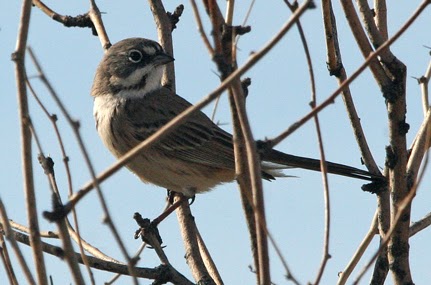
I checked through my notes and photos and found that I do not have a photo of Bell's Sparrows from Ukiah, California.  I saw and heard Bell's (Sage) Sparrows at Cow Mountain Recreation Area east of Ukiah with distinct white marks in the lores and very gray heads and unstreaked backs.  I heard the tinkling call of Sage Sparrows, which are similar to juncos.  In addition, I also saw Fox Sparrows, which I obviously photographed.  The Fox Sparrows had a very thick call note, "tschup."  I am not sure where the "Salt" came from in the name I previously used, Saltbrush Sparrow instead of Sagebrush Sparrow.  I wrote a lot of that blog post for Arizona very early in the morning at Adak when I got up regularly at about 4:00 am.  Maybe I wasn't really awake as claimed by my Adak colleagues!  :>)  :>) 

With regard to the record of Bell's Sparrow, I believe that I saw and photographed the canescens subspecies of  Bell's Sparrow at the Thrasher Spot in Arizona.  Bell's Sparrow includes belli and canescens.  Belli has a dark grey head, thick malar stripe and no (or sometimes very little indistinct) streaking on the back while canescens has little streaking on the back and a malar strip that is intermediate in width between the very thin malar strip of Sagebrush Sparrow (nevadensis) and the thick malar strip of belli.  In general, canescens is intermediate between belli and Sagebrush Sparrow.  I have used the excellent summary article about field marks, http://phainopeplafables.com/2013/08/14/sage-sparrow/ by David Vander Pluym, which points out that the width of the malar strip may be the best field mark to distinguish the two new Sage Sparrow species, Bell's and Sagebush, as well as the canescens subspecies.  See also Neil Hayward's discussion on his Accidental Big Year Blog.  Below I include photos of what I believe are Bell's Sparrows, the canescens subspecies with the rationale included in the captions.
Bells Sparrow (canescens)
very little to no streaking on back, intermediate width malar stripe
Bell's Sparrow (canescens)
same bird as above, slightly different view
Bell's Sparrow (belli or canescens?)
apparent thicker malar stripe may be caused by the angle of viewing, light and shadows, unstreaked back


Bell's Sparrow (belli or canescens?)
same bird as immediately above, note difference in appearance of malar stripe

Bell's Sparrow (canescens?)
same bird as immediately above
notice how angle of viewing and light affects the appearance of malar strip
It is an adventure in field identification to identify these new species and related subspecies of Sage Sparrow.  I make no claim to expertise in this area, and have learned a lot and will probably learn more in the future on how to identify these new species and subspecies of Sage Sparrow.   There is a lot of variability across individual birds of these two new species and of the existing subspecies.  If time permits this year, I will try to see the belli subspecies of Bell's Sparrow, if my path to other new birds of the year takes me within range of belli.  The reason for wanting to see both canescens and belli is to preserve a possible additional species if canescens is split in the future as a separate species.

There is no change in my total species list reported in my post, Clean Sweep in Arizona.     


Tuesday, December 10, 2013

Correction to Last Post of Early Today

The photo of the reputed Bell's Sparrow is a Fox Sparrow--large bill, totally gray face, heavily streaked.  I'm checking my records and photos.  I may have included the wrong photo in haste.   I thought that I saw and photographed Bell's Sparrow.  I may need to remove Bell's Sparrow until I see it again on my return to the lower 48 to Phoenix, AZ early tomorrow.   Sorry for the confusion. Thanks to Andy Boyce for the alert and help.

Clean Sweep In Arizona, December 1 and 2 on My Way to Alaska

I flew to Phoenix, Arizona on my way to Alaska.  For this short visit to Arizona, my target species were Le Conte’s and Crissal Thrasher, Sagebrush Sparrow and Rufous-backed Robin.  I arrived in Phoenix, Arizona from Columbus, Ohio, December 1 at about 1:30 pm about one hour later than scheduled.  Originally, my second flight from Las Vegas to Phoenix was scheduled to leave at 10:30 am but was delayed until 11:25 am.  I had heard from my friend Neil Hayward that it was colder than expected in Phoenix and north to Cameron Trading Post for the Rufous-backed Robin; therefore. I dressed for colder weather than normally expected for Phoenix, AZ.  However, it was warmer than I expected, and I took off my long-johns before picking up my rental car.  Getting the rental car also took longer than expected.  With all the delays and being very tired from very little sleep last night, I changed my plans to first going to The Thrasher Spot at Baseline Road and Salome Highway south west of Phoenix early next morning to try for LeConte's and Crissal Thrasher and Saltbrush Sparrow, and then drive the 3.5 hours to Cameron Trading Post north of Flagstaff to try for the Rufous-backed Robin.  If this plan worked out, I would leave for Anchorage, Alaska to try for the Dusky Thrush and then join John Puschock, Neil Hayward and Bill Pierce in Adak to try for Whooper Swan and other rarities and then go to Nome for McKay's Bunting before returning to Arizona.  I fell asleep very early after getting food for an early dinner and got some much needed rest. 
 
I got up early and arrived at Baseline Road and Salome Highway a little before 8:00 am.  Sunrise was at 7:30 am, and I wanted to be there by sunrise, but my need for rest delayed my departure.  There are two websites that give good instructions about where to look, www.birderfrommaricopa.com under The "Thrasher Spot" at Baseline Road/Salome Highway and www.aztrogon.com by Stuart Healy, Western U. S. Bird Guide, where one can download a pdf document, Le Conte's Thrasher near Buckeye.  I started walking through the low and sparse sage brush, maybe creosote, bushes the best area to look for LeConte's Thrasher.  At first, I saw only White-crowned and Sage Sparrows from a distance, but finally heard Le Conte’s Thrasher singing softly apparently from a distance.  Eventually, as I got further from the roadside I started hearing the distinctive call notes of Le Conte's Thrasher and then a singing Le Conte's Thrasher.  Soon, I found the apparent Le Conte's Thrasher sitting up on a low tree, an apparent creosote bush, singing.  As soon as it saw me, it dropped immediately to the ground and disappeared.   I searched the area where the Le Conte’s Thrasher disappeared and soon heard a Le Conte’s Thrasher calling, a whistled single note, “tweeep.”.  As I moved slowly toward the calls, a gray streak shot out of the bushes running full tilt like The Roadrunner in cartoons.  It was a Le Conte's Thrasher.      Welcome to the world of Le Conte’s Thrasher!  Eventually, I was able to follow the Le Conte’s Thrashers from a distance and see them running away and sitting still to check out the source of disturbance to their territory.     I was eventually able to get closer looks by walking slowly and stopping and looking.  The LeConte's Thrashers are curious and will often stop to look around and give reasonable views.  I was able to get some photos.  See below.

Le Conte’s Thrasher is a very light gray with light brownish tinges on the back, a long black tail with white on the outer edges (sometime at least depending on wear), has whitish throat, breast and belly with tawny undertail coverts and is very secretive and spends significant amount of time on the ground running from bush to bush.   I am including more photos of this secretive and hard to photograph bird.  At first, I obtained very distant views of Le Conte’s Thrasher with tail up running away see photo below showing the tawny undertail coverts. 
Le Conte's Thrasher, running away, showing tawny under tail
Le Conte's Thrasher, tawny under tail, still running away
very abraded tail, edges worn off, leaving pointed tail feathers
Occasionally, a LeConte’s Thrasher would stop to look around to check out what flushed it.  See photos.  (Note:  This bird is still in molt.  The abraded tail feathers on which the white edges are worn off leaving a very pointed tail feather and the central shaft.  See photo above.) 
Le Conte's Thrasher, curious about me,
very gray on upper parts, dark tail
Eventually, I was able to get some distant photos of LeConte’s Thrasher perched on a low sagebrush bush.   See photos below. 
Le Conte's Thrasher,
light gray upper-parts, whitish under-parts, long bill, dark eye, long dark tail,
tawny under tail 
Le Conte's Thrasher
Finally, I found a cooperative LeConte’s Thrasher sitting up and singing in an apparent creosote bush.  It also appeared that there may have been a pair setting up territory, because I saw two birds chasing each other.   See photos (note abraded tail feathers) below.
Le Conte's Thrasher, singing
note abraded tail feathers
Le Conte's Thrasher, singing
While I was stalking the Le Conte’s Thrashers, I heard a Crissal Thrasher calling giving a two or three noted “toit toit toit” call.  I tried to find the Crissal Thrasher, but was unsuccessful.  Crissal Thrashers are very secretive, probably our most secretive thrasher, and I never got a look at a Crissal Thrasher.

While searching for Le Conte’s and Crissal Thrashers, I saw quite a few Sage Sparrows in the area.  Satisfied that I had added Le Conte’s Thrasher and Crissal Thrasher (heard only), I concentrated on identifying the Sage Sparrows and finding a Sagebrush Sparrow.  Sage Sparrow has been split into two new species, Sagebrush Sparrow and Bell’s Sparrow.  I had seen Bell’s Sparrow, near Ukiah in northern California at Cow Mountain Wildlife Area back in the fall.  I found several Sagebrush Sparrows with streaked backs, rather thin malar stripe along the throat, very white underparts with some but not much streaking and with a short whitish supercilium.   See photos below.  
Sagebrush Sparrow
fine streaking on back
Sagebrush Sparrow,
fine streaking on back, thin malar streak along throat
Bell’s Sparrow, in comparison, has much wider malar stripes along the throat, very gray head and mantle, more streaking along the sides and unstreaked back.   See photos taken within the known range for Bell’s Sparrow near Ukiah, California at Cow Mountain Recreation Area, showing the very wide malar streak along the throat, the extensive streaking along the sides and unstreaked gray back.
Bell's Sparrow,
heavy malar mark/line, streaking along sides
Bell's Sparrow,
gray head and back, unstreaked back
At about 10:30 to 11:00 am, bird activity slowed down and I headed north to Cameron Trading Post north of Flagstaff to try for Rufous-backed Robin.  It was almost a 3.5 hour drive from The Thrasher Spot at the intersection of Baseline Road and Salome Highway.   I stopped to pick up lunch and buy gas just outside of Flagstaff.  See photo. 
Snow capped mountains in Arizona.
Must be Flagstaff
I arrived at Cameron Trading Post about 3:20 pm.  See photos of Cameron Trading Post, the garden and the Russian Olive Trees outside the brick wall surrounding the garden.  I found the garden area where the Rufous-backed Robin was hanging out around to the right.  The garden is surrounded by a brick wall.

Cameron Trading Post, garden around to right
garden, corner where robins hang out to right of motel between trees
Russian Olive trees outside the brick wall
I found the Rufous-backed Robin by 3:30 pm.  That’s quite amazing given the usual shyness of this bird.  It was hanging out with a flock of American Robins.  My first views were obscured by branches, because the bird tended to perch inside the bushes.  See photo below.
Rufous-backed Robin, being secretive
"I can see you, but you cannot see me!  Oh yes I can!"
I discovered that the Rufous-backed Robin and the American Robins were flying into the Russian Olive trees outside of the brick wall surrounding the garden.  Consequently, I hid around the corner of the motel by an entrance outside the wall and waited for the Rufous-backed Robin to come back outside the wall to feed.  The Rufous-backed Robin came to a nearby branch to get some russian olives, resulting in these very good photos showing the yellow bill, the gray head with no white around the eye, the long streaks on the throat, the rufous back and wing coverts and the white extending to the lower breast in a point.
See photos below.
Rufous-backed Robin,
gray head without white around eye, long streaks on throat, rufous on back
and wing coverts

"Hmmm.  I wonder if this russian olive would be better with russian vodka?"
 
Rufous-backed Robin
with russian olive

 
Rufous-backed Robin,
rufous back and wing coverts
Rufous-backed Robin,
Rufous back and wing coverts

Whoa!  Feeling a little tipsy now! Who spiked these russian olives?"
I left Cameron Trading post at about 4:30 pm and headed back to Phoenix.  Tomorrow, I will be flying to Anchorage, Alaska to try for the Ducky Thrush, and if successful, will fly out to Adak to try for the Whooper Swan and any other rarities that might turn up there.  After that I head to Nome to try for the McKay’s Buntings seen there recently by Neil Hayward.

Le Conte’s Thrasher, Crissal Thrasher, Sagebrush Sparrow and Rufous-backed Robin raise the total to 708 + 2 (White-cheeked Pintail and Common Redstart).


Thursday, December 5, 2013

Stranded in St. John's New Foundland--It's Gulling, November 27, 28 and 29

I drove through intermittent rain the afternoon of November 26 to the airport in Halifax.  I was the last person to board the plane on a Porter flight as they started announcing that the gate was closing!  I arrived in St. John's at about 7:00 pm.  I had not had time to reserve a rental car and hotel room, given that this trip was done on the fly.  In the airport, I reserved a vehicle and a hotel room, picked up the car and drove to my motel. 

No telling what the approaching storm may bring over the next few days!  My original plan was to stay in St. John's for one day, get the Yellow-legged Gull and then fly back to Halifax and drive to Digby, NS to take the ferry back to St. John, NB.  It was a nice plan in theory!  Neil Hayward had done this about one week ago.  However, very soon on Wednesday, November 27, I got a phone message stating that the ferry from Digby, NS to St. John, NB was cancelled.  Obviously storm related.  I found out later that flights from Halifax to St. John's and St. John's to Halifax were cancelled due to the high winds from the storm.  It can be galling when one is stranded at a location unexpectedly and with no plans for things to do.  However, this is St. John's, a premier place for gulls in the winter time, so gulling it is.

Neil Hayward had forwarded suggestions on where to look for the Yellow-legged Gull which Jared Clarke, a local expert, had provided.  I contacted Jared, but he was busy with work and might stop by briefly.  I started at Quidi Vidi Lake in the morning to search the gull flocks on the lake and on the nearby roof-tops.  It was partly cloudy to cloudy with intermittent sunshine.  I walked almost three quarters of the way around the lake checking out the gulls on the lake.  Gulls flew into the lake to bath, drink and rest and then flew back to the roof tops or off to undisclosed locations.  There were thousands of gulls to sort through.  To find the Yellow-legged Gull in flocks of the abundant Herring Gulls, I looked for a gull about the same size as Herring Gull, maybe slightly smaller, with a gray back color intermediate between Herring Gull and Lesser Black-backed Gull.  To demonstrate the color difference, below is a photo showing a Herring Gull and a nearby Lesser Black-backed Gull for comparison, in this case roosting on the ground.  The Lesser Black-backed Gull is the slightly smaller gull in the middle with yellow legs and feet, dark gray mantle and wings.  A Herring Gull is immediately to the left and slightly behind the Lesser Black-backed Gull.  The larger gull with a dark black mantle and wings to the right and slightly closer is a Great Black-backed Gull.  This photo was taken on a cloudy day, which can affect the apparent shade of gray, and this Lesser Black-backed Gull may be a slightly darker bird.  Jared Clarke told me that there is variation in the shade of dark gray between different Lesser Black-backed gulls here at St. John's.  
Herring Gull, Lesser Black-backed Gull and Great Black-backed Gull
Finding particular gulls in the flocks of gull is like trying the find a needle in a haystack.  See photo below, showing a typical flock of gulls roosting on the ground.  The above photo was a central cut of this photo below. 
Typical gull flock


In the flocks on the lake I also found Iceland Gulls, a few Glaucous Gulls, one or two Lesser Black-backed Gulls and a small flock of Black-headed Gulls but not the Yellow-legged Gull I was seeking.  I checked nearby roofs where gulls were roosting and then moved north of the lake to look for a grassy hillside off of Chartier Avenue where gulls roost and is a good spot for Yellow-legged Gull.  No luck.  I noticed the effect of light on the relative shade of gray visible on gulls in St. John's.  The lighter gray of the mantle and wings of Herring Gull can sometimes appear darker depending on the angle of viewing and the angle of the light striking the bird.  In addition, when a Herring gull is preening its wings, the wings can sometimes look a darker gray, which disappears when the bird folds its wings into the normal closed position.  Later during my stay when I met Jared Clarke, he verified that he has observed this same effect.  Finding the Yellow-legged Gull s likely to be quite difficult!  Toward the east and north of the lake in Pleasantville, there were large flocks of gulls on the roofs of apartment and business buildings.  I found a spot on Janeway Place up the hill where I was able to scan these roofs looking down from above.

Between 2:00 and 2:30 pm, I found a gull on one roof buried in the flock and showing only partially that looked to be the intermediate shade of gray between Herring Gull and Lesser Black-backed Gull.  I studied this bird for a long time through binoculars and telescope.  Eventually, the other gulls moved.  The gull in question seemed rather large.  That didn't seem right for the Yellow-legged Gull.  Eventually, this gull turned and morphed into a Great Black-backed Gull!  The light conditions and my angle of viewing caused this effect.  The sun was dropping in the west, the sky was clearing, and the bright sunlight was at an angle that made the black color of the mantle and wings appear to be an intermediate gray.  When this Great Black-backed Gull turned, it stood right beside another essentially identical Great Black-backed Gull, both showing the dark black mantle and wings.  Wow!  Identifying a Yellow-legged Gull will require great care!   I continued to scan, and found an interesting bird on a far roof, that looked smaller than the Herring Gulls next to it, but with a gray mantle and wings that looked intermediate between Herring Gull and Lesser Black-backed Gull.  This was a very interesting gull!  The legs and feet looked yellow.  The crown and back of the head looked very white.  When it turned its head, the crown appeared flat and peaked in the back.  I could not see any streaking on the head, but that could may been the effect of distance.  When the gull turned its head, the bill showed a large red gonys spot and looked relatively thicker than the bills of the nearby Herring Gulls.  All of these field marks are good for Yellow-legged Gull.  I got my camera on this bird for a very long distant photograph and managed the two best photos shown below.   Shortly after getting the photos at about 3:30, all the gulls flew from this and nearby roofs circled high and disappeared.  The sun started to set rapidly and gulling was done for the day at about 4:00 pm, because most of the gulls in the area vanished as if into thin air.  Pun intended! 
Yellow-legged Gull?,
middle on roof edge, under left flying gull,
intermediate gray, apparent yellow legs and feet,
very white head, effect of late day light?
Yellow-legged Gull?, another view
I was communicating with Neil Hayward about this bird, and he suggested that I send the photos to Jared Clarke.  I did, and asked Jared's opinion.  Jared said my description about the head and bill sounded right for Yellow-legged Gull, the back color seemed right, the head was very white, the legs and feet appeared to be yellow, and this gull was a fair bit smaller than Herring Gulls, which is often the case for Yellow-legged Gull.  However, this gull may be too much smaller than Herring Gull, hard to tell with a very distant photo which lacks in good views of the details.  Also, Jared pointed out that without details in this distant photo, it is hard to rule out hybrids that are present, and that I will need to decide if I saw enough to count this bird.  I had nagging doubts given the relatively smaller size and particularly the effect of late day light that I had just experienced.  I looked on the internet and found a photo of this Yellow-legged Gull when it was first found in October by Bruce Mactavish, another expert from this area.  His photo from the same angle with Herring Gulls looked very similar to mine.   That was very encouraging.  However, his photo was obtained on a cloudy rainy day with diffuse light, better conditions than mine to see the differences in the shades of gray.

Thursday, Thanksgiving, November 28, was very windy, as the storm approached, and it got more windy during the day.  Jared Clarke had alerted me to the fact that on windy and rainy days, the gulls avoid the roof tops and roost on the playing fields just north of the lake along The Boulevard, on the grassy hillside off Chartier Avenue, the Bally Hally Golf Course or on a field near the landfill off East White Hills Road.  His advice was right on target.  Thanks, Jared!  I started at the playing fields.  It was shoulder to shoulder with gulls packed on the grassy areas of both playing fields (baseball).  I spent several hours scouring the flocks, but found only a darker backed Herring Gull that caused initial excitement until I saw its pink legs and feet.  I also found an adult winter plumage Lesser Black-backed Gull.  The gulls flew into these two flocks and back out to the lake with constant change over of birds.  Eventually, the roosting flocks on the playing fields decreased in size, and I was not seeing anything new nor, in particular, the Yellow-legged Gull.  I checked the lake.  No Yellow-legged Gull!  I drove to the landfill area and found the large flock on a field near the landfill.  There were massive flocks of thousands of gulls the rising in the air above the landfill (off limits) and then dropping down out of sight.  I scanned the flock on the field and took the photos show above of gulls on the ground.  I checked the grassy hillside just north of the lake off Chartier Avenue.  No gulls at all!  Same at Bally Hally Golf Course!   I spent the rest of the day rotating between the playing fields, where the flocks got very small later in the afternoon, the lake and the field near the landfill.  No Yellow-legged Gull!  I ended the day at the field near the landfill.  No Yellow-legged Gull!  Well, tomorrow is another day and needed to be my last.  The weather was predicted to improve.  Flights would be back on schedule.

I tried to make a flight reservation to leave on Friday, November 29, on the Porter website, and something locked up with my reservation.  In the morning on November 29, I stopped by the airport to try to talk to a person instead of a computer.  After getting my reservation issues resolved and receiving a confirmation e-mail, I started birding again.  There was very little wind and the sky was clear with bright sun.  Jared's prediction of gulls on the roof with low wind was right on.  No gulls on the playing fields, Bally Hally Golf Course or the grassy hillside north of the lake.  I stopped at the lake on the south side where I had the sun at my back.  There were large numbers of gulls on the lake.  I started scanning and found a gull on the water with an intermediate gray mantle, apparently lighter than Lesser Black-backed Gull but darker than Herring  Gull.  I got excited and stayed with this gull as the flock moved west on the lake from the vicinity of the boathouse.  Unfortunately, this gull had dark streaking on the face, but a very white nape and back of the head, but there was lighter streaking apparent at close range on the nape.  This gull had yellow legs and feet and a primary pattern that seemed intermediate between Herring Gull and Lesser Black-backed Gull due to more white being present in the primaries.  I concluded that this bird was either a hybrid between Herring and Lesser Black-backed Gulls or a Lesser Black-backed Gull in a slightly different plumage.  Again, the bright sunlight could have affected the appearance of the shade of gray on the mantle and wings.  See photos below.

Lesser Black-backed Gull or Yellow-legged Gull?, left
too much head streaking?, with Herring Gulls,
Lesser Black-backed Gull?
note different shades of gray on Herring Gulls, depends on position to light

Lesser Black-backed Gull?, right,
more than normal white in primaries, still in molt
Herring Gull, left 
By this time it was close to lunch time.  I got a sandwich at the Dominion grocery store right next to Quidi Vidi Lake, where I had bought lunch the previous two days, and then returned to the lake for one last look before changing locations, at least that is what I told myself.  I was standing just west of the boat house after  a cloud cover moved in and reduced the sunlight to diffuse lighting and the glare, when a flying gull  from the east low over the water caught my eye.  Holy cow!  That looks like a Yellow-legged Gull!  The intermediate gray on the mantle and wings was apparent and darker than the nearby Herring Gulls but not too dark.  The head was very white!  The gull landed and started bathing.  I could see the almost immaculate white head and a very flat crown.  The bill was thicker than that of the nearby Herring Gulls with a blunt end and a very large red gonys spot.  Now I had to see the legs and feet.  I had already started taking photos.  The bird took off revealing the yellow legs and feet.   It flew west as I continued getting flight photos hopping that I would catch the pattern in the primaries.  This gull circled east and I watched it until it disappeared in the vicinity of the apartment roofs near where I had the maybe Yellow-legged Gull on Wednesday.  I was certain that this was a Yellow-legged Gull.  I called Jared Clarke to ask him if he could stop by to take a look at my photos.  I would be leaving this evening and wanted his opinion on this bird.  I had looked at the flight photos and the primary pattern was consistent with Yellow-legged Gull.  I asked Jared to meet me at Janeway Place where I was headed to hopefully find the gull again on the roof tops.

Jared arrived and we meet for the first time.  I showed him the photos.  His first words were "You got him."  Then he described what he could see in my photos, the thick blunt "butter knife" shaped bill the large red gonys spot, the greater amount of black in the primaries at the wing tips above and below than in Herring Gull and the intermediate dark gray of the mantle and wings that is darker than Herring Gull but not as dark as in Lesser Black-backed Gull and the yellow legs and feet.  I was ecstatic!  Yes, finally, a good Yellow-legged Gull!  A great new life bird and new for the year!   See photos below.
Yellow-legged Gull,
darker gray than herring gulls behind, much lighter than Great Black-backed Gull to right,
flat crown, thick blunt bill, large red gonys spot on bill, very fine streaking on face but very white head
Yellow-legged Gull,
yellow legs and feet!

Yellow-legged Gull
more extensive black in wing tips above and below than Herring Gull
and without white in the gray tongues, butter knife shaped blunt bill, very white head

Yellow-legged Gull,
yellow legs and feet visible in flight.

This yellow-legged gull seemed to lack the smaller white spot/window on primary number nine, the second from the wing end.  the National Geographic field guides shows a white window on P10 and P9.  Jared explained that for the race of yellow-legged Gull from the Azores that shows up in St. John's, the white window on P9 may not be present.  Jared had to run.  Briefly, he told me about the problems with the light here at St. John's to identify this gull.  On clear sunny days, he does not look  for gulls, only on cloudy days where the light is diffuse.  I wished I could have talked birding with him more.  I promised to send him my best photos shown above.  They are not prize winners but document the field marks well enough.  This bird is a tough subject--always moving for me and not staying around very long. 

Later when I sent Jared these photos, he told me how blessed I was to see this bird well and also twice.  Well, I think the first sighting is a maybe, but this last one is the real deal!

When Jared left, I headed for the airport.  I had a long trip back home to Ohio first and then to Arizona and then probably to Alaska.  My flight to Halifax left at 5:45 pm.  I arrived in Halifax and then drove to St. John, New Brunswick taking the western route and stayed the night.  In the morning, I got a refund for my ferry trip from Digby, NS to St. John, NB, and then drove to Manchester, New Hampshire.  I flew from Manchester, NH to Dayton, OH via Baltimore, MD arriving at home at about 12:30 pm.  I needed to pick up my new credit card in the mail.  My previous one had been compromised by poor security at a vendor.  It was a short night.  Soon, at 7:30 am, I was on  my flight from Columbus, OH to Phoenix, Arizona, on my way eventually to Alaska.  More later and more to come!

Yellow-legged gull is life bird number 811 for the ABA Area and new for the year raising my Big Year total to 704 + 2.    


Monday, December 2, 2013

A Wild Goose Chase, November 24 to 26

A Tundra Bean Goose is in Yarmouth, Nova Scotia.  Bean Goose has been split into two separate species, Tiaga Bean Goose and Tundra Bean Goose.  I have seen a Bean Goose before at the Salton Sea in 2010, but that was a controversial bird.  The exact species, Tiaga or Tundra was not determined conclusively, if I recall correctly.  However, some observers believed that it was a Taiga Bean Goose.  If I go to Nova Scotia for this Tundra Bean Goose, I will also go to St. John's, New Foundland to try for Yellow-legged Gull, a life bird for me.  It is a long way to Nova Scotia and St. John's, New Foundland; therefore, it is more efficient for time and cost to try to get both birds on one trip.  Neil Hayward just did this, driving from Boston, and got both birds.

Last week, on Thursday, I  cleaned up the leaves on my property, shredded them and put into my compost pile.  Cold weather was coming, and cleaning up leaves gets more difficult after there is snow on them.  I also spent the rest of last week catching up with my blog.  However, soon it was time to return to birding. 

On Sunday, November 24, I flew to Manchester, New Hampshire, and drove to St John, New Brunswick.  I arrived in time to get on the St. John, NB to Digby, NS ferry leaving on Monday, November 25 at 9:00 am Atlantic Time.  It was a long night with sleep only on the flight.  I managed to stay awake most of the ferry ride to Digby, Nova Scotia.  In the first third of the trip I saw at least one or maybe two Atlantic Puffins flying diagonally away from the boat.  I saw a black and white fat flying football showing no neck.  This bird or potentially a second quite distant bird was not as long as a Common Murre, many of which I had a chance to study extensively on my trip to Attu in May.  I also saw Long-tailed Ducks, which could possibly be confused with Atlantic Puffin at a distance, if they are still in breeding plumage with black wings and black backs.  However, Long-tailed Ducks show necks in flight and smaller heads.  I had worked through this identification pitfall for Long-tailed Duck in Barrow, Alaska with Big Year birding buddy Neil Hayward and tour leader John Puschock while looking for Ross's Gull.  As Neil told me in an e-mail about the Atlantic Puffin, "a lucky save at the end of the year" and addition to my Big Year list.  However, it was not all luck.  Neil had alerted me to the fact that he had seen an Atlantic Puffin on the St. John to Digby ferry.  Consequently, I was prepared to watch for this bird.  Luck is significantly influenced by being prepared and in position to be lucky.  Thanks Neil for the tip!  I fell asleep for about one third of this scheduled 3 hour trip.  However, I saw birds on my way across, even though it got quite windy with a lot of wave action out in the middle.  I saw about a dozen Black-legged Kittiwakes, the most common bird seen on the way across, two Northern Gannets, as well as the birds previously mentioned.  The trip across took 3.5 hours due to the windy conditions.  Therefore, I arrived in Digby at 12:30 pm.  It took a while to unchain the large trucks at the dock in Digby, NS.  Finally off the ferry, I drove immediately to Yarmouth to look for the Tundra Bean Goose.  Unlike, Neil, I decided to pay for taking my rental car across on the ferry.  If I had not done so, I would have rented three vehicles at the same time, during my total trip, including going to Halifax and flying to St. John's, New Foundland.  That seemed too much for me, and too time consuming.

I arrived in Yarmouth at the country club between 1:30 and 2:00 pm and started looking for the bird.  I went to the country club first, a key landmark for Google Maps, and then went to the favorite location for the goose on S. Main Street.  At the country club there was no goose on the fairways to the west.  I walked around the club house to look for the small pond where the Tundra Bean Goose has also been seen.  I found a flock of Canada Geese, but could not find the Bean Goose in this flock.  As I tried to get closer to be able to see all of the geese, the Canada Goose flock took off and flew west toward the inlet to the west.  I found my way to S. Main Street to the place where a path from the golf course meets the street.  No goose on the golf course, only a few gulls and Mallards.  I started to get worried that the goose was gone.  It had been reported the two previous days, but yesterday there was snow here, and the goose was reported to be eating grass in the blowing snow.  Was this preparation for leaving?  The previous reports were mostly earlier in the day than my arrival.  I searched the area repeatedly, south on S. Main Street, the inlet to the west from many vantage points from Water Street, and from streets to the east to scan the golf course for areas not visible from the club house, but never found the flock of geese or the Tundra Bean Goose.  As the sun set at about 4:00 to 4:30 pm, I gave up for today and found a motel to stay in Yarmouth and try again tomorrow morning.  I felt confident that the goose was still here, but just being uncooperative. 

After breakfast in the nearby motel on Tuesday, November 26, I drove to the country club.  No geese there!  Then I checked the favorite spot on S. Main Street, no geese there!  Uh, oh!  I drove slowly south on Main Street checking the golf course to the east through openings between houses and found a flock of Canada Geese roosting on the golf course.  I drove back to the path to Main Street, the favorite spot, parked at the pull-off, grabbed my camera and binoculars and walked along the course edge to get a vantage point to scant the geese.  At a spot where there was a row of bushes through the course, I stopped to scan the flock using the bushes as a screen to not spook the geese.  At first no, Tundra Bean Goose, but wait there it is!.... as it stood up to change positions and then dropped out of sight again.  The geese were laying down and eating grass.  I made my way to a group of large rocks near the geese and got this long distant photograph of the Tundra Bean Goose, showing the dark brown head and orange ring on the bill near the tip, but, of course, I wanted a better view and picture. 
Tundra Bean Goose laying down, with Canada Geese
However, soon the Canada Geese got spooked by my presence, even though I stayed hidden behind the rocks, and took off and circled out to the inlet.  I walked back to my car, and met a local man who regularly feeds the crows at the path to S. Main Street.  He told me that the Tundra Bean Goose was present yesterday morning about this time of day, snoozing right near the path at the nearby green.  That was encouraging and good news.  I told him about the flock of Canada Geese, and he told me about the geese feeding on the exposed eel grass at low tide, and drove there as I followed to show me the area.  Yesterday, I checked this area but it was covered by water.  This morning the Canada Geese were grazing on the eel grass.  However, the Tundra Bean Goose was not with this group.  I spent a long time scanning and rescanning this group.  Soon the tide started coming in again.  A flock of Canada Geese flew over from some undetermined location and flew back toward the golf course.  I went back to the club house and checked behind the club house.  There was a flock of geese out on the course but not all geese were visible, only the ones near the top of a small hill.  After checking all of these geese, I drove to a street east of the golf course to check the other side of the hill and an area near a small pond.  No Tundra Bean Goose!  Now this is really beginning to feel like a wild goose chase!

I drove back to the inlet near the sewage treatment plant.  The flock of geese were still there, but the eel grass was rapidly getting covered by the in coming tide.  Still no Tundra Bean Goose!  I drove back to the path from the golf course on S. Main Street.  There was the Tundra Bean Goose!  It was on the fairway near the tee for the 16th hole.  I grabbed my camera, and walked out the path.  The crow feeding man told me that the goose could be approached unlike the Canada Geese.  I saw the dark brown head and upper neck, the orange ring near the tip of the bill and the orange legs and feet of Bean Goose.  Bean Goose has been split into two species, the smaller Tundra Bean Goose and the larger Taiga Bean Goose.  I saw the relatively short neck, the relatively deep base to the bill and the relatively blunt tip, the grin patch, all of which are indicators of Tundra Bean Goose.  Both halluces, the hind toe, are intact, indicating a bird not held in captivity and wild.  One is shown in one of my photos below.
Tundra Bean Goose
dark brown head, orange ring on bill, grin patch, orange legs

Tundra Bean Goose,
note the intact hallux, indicating not been in captivity, orange legs and feet
Yes!  A great new bird for the year!  I stopped at the local Best Western Motel where I stayed.  At breakfast, I had told my Big Year story to the manager and another person who stayed there .  They were very excited about it.  I promised the manager that I would stop by and show her my pictures if I found the goose.  She enjoyed my photos.

As the rain started to fall due to the approaching storm, I headed to Halifax to fly to St. John's, New Foundland to try for the Yellow-legged Gull.  Halifax is 3 hours and 18 minutes north.  I had just enough time to make it to a flight leaving at 4:45 pm.

Atlantic Puffin and Tundra Bean Goose are new birds for the year raising the total to 703 + 2 (White-cheeked Pintail and Common Redstart).

I am writing this from Phoenix, Arizona.  This morning I try for Crissal and LeConte's Thrashers and Saltbrush Sparrow at the Thrasher Spot at Baseline Road and Salome Highway.  I had only a small amount of sleep on Sunday morning on my flights from Ohio to Phoenix.  I fell asleep early last night.  This afternoon I will drive north to Cameron Trading Post north of Flagstaff to try for the Rufous-backed Robin.  Then, I am headed back to Alaska to try for the Dusky Thrush in Anchorage, Whooper Swan on Adak and McKay's Bunting in Nome.  After that, back to Arizona and California.  It will be an interesting December this year!  


Wednesday, November 27, 2013

Stalking the Wild Aparagus, Whoops, I Mean Ring-necked Pheasant, November 19 and 20

On Tuesday, November 19, I arrived at Maumee Bay State Park before sunrise and proceeded to the area near the hill.  A pair of Great Horned Owls were calling with higher pitched and lower pitched hoots.  I stayed in the area for an hour or more but neither heard nor saw a Ring-necked Pheasant.  Then I drove toward Ottawa NWR and looked and listened along Krause Road but also without success.   I spent some time at the grassland area at the intersection of Krause Road and Route 2 and eventually walked the cut trail through this grassland, but again found no Ring-necked Pheasant.

The reason for looking at  Maumee Bay State Park is that in the 5 years prior to this year I have had Ring-necked Pheasant there every year.  When I moved to Ohio in 1994, Dan Sanders and Greg Miller told me that Ring-necked Pheasant at Maumee Bay State Park are more likely to be wild birds.  They had been there for a long time 20+ years, at  least.  There is no hunting and no state stocking program at Maumee Bay State Park.  At popular hunting areas around the state, such as Killdeer Plains WA, cock-bird Ring-necked Pheasants are released as many as four times throughout the pheasant hunting season starting on November 1 and ending January 5 to facilitate the hunting experience.  A list of the release site is published each year.

I had contacted Sherrie Durris who lives near Maumee Bay SP, birds there regularly and is knowledgeable about birds in the area.  She said that she often sees Ring-necked Pheasant at Maumee Bay SP but not this year.  Sherrie knows of a private person who raised some Ring-necked Pheasants and released them at Maumee Bay State Park  within the past two years.  That is a fly in the ointment of the wild theory.  Whether Ring-necked Pheasants are wild or not is a  matter of degree.  All Ring-necked Pheasants in Ohio and elsewhere in the US originated from released stock.  It depends on how long pheasants have been breeding in the area.

I spent the afternoon walking more trails at Maumee Bay State Park.  I found a Northern Shrike on the trails west of the hill toward the camp ground.  Late in the afternoon, I gave up looking for Ring-necked Pheasant at Maumee Bay State Park and headed south toward home.  I had contacted Doreene Linzell to find out where she and Dan Sanders had found Ring-necked Pheasant for their Ohio Year List.  Doreen told me that in the spring they heard Ring-necked Pheasant at Pickerington Ponds where pheasants have been for about 20+ years.  Guess I'll try there in the morning.

On Wednesday, November 20, I arrived early at Glacier Knoll picnic area at Pickerington Ponds and walked out to the overlook.  I listened for a while and then played the crowing call of Ring-necked Pheasant, which I had also used at Maumee Bay State Park.  After the second go around of calls, a Ring-necked Pheasant gave the cackling male alarm call from the nearby high grass and goldenrod.  I turned off the crowing call and the bird kept giving the male alarm call.  I checked the area where the calls came from and found that it was thick with blackberry brambles.  I wonder if the blackberry brambles help the local Ring-necked Pheasants to survive and escape the local coyotes?  Could be.  This bird was very secretive and did not show itself, perhaps an indication of some wildness.  I was satisfied and left the bird alone.

Ring-necked Pheasant raises the total to 701 + 2.