Wednesday, March 5, 2014

Tanque Verde Wash from Wentworth Road, December 22

Here is a special thank you to my birding buddy Isaac Sanchez for sharing the location of the Gray Vireo, which I added to my list yesterday.  Very much appreciated.  I had almost given up on that bird as hopeless to find in December.                     

I got up very early on December 22, completed and published my post that I had started, Last Days at Adak: December 8 –December 9.  Then, I completed and published an updated post, Quick Update Post-Alaska and in Arizona and New Mexico, to give readers the latest news about species seen in Arizona.  Consequently, I got a late start for the morning, picked up breakfast to go just before 10:30 am and arrived at Tanque Verde Wash on Wentworth road between 11:00 and 11:30 am.  I did not expect this late start to be an issue, because the early mornings were quite cool, keeping insect activity down.  I expected more activity for a Dusky Flycatcher later in the morning; at least that is what I hoped, when insect activity should be higher with higher temperatures.
While I was on my way to Tanque Verde Wash, Neil Hayward texted me about reports of Dusky Flycatcher on eBird on December 11 and 14 and a report of Lawrence’s Goldfinch eBird at Ina Road at the Santa Cruz River.  I had texted him yesterday that I was looking for these birds next after giving him a daily update.  When I arrived at the wash, I texted Neil back, joking that it must be ESP, and we were starting to think alike.  I was only 4.6 miles from the intersection of Tanque Verde and Wentworth Road when Neil first texted me, and I had also targeted the Lawrence’s Goldfinch at Ina Road.  Neil texted back, “Big Year birders are birds of a feather!”  I got a good chuckle out of that!

At the parking area along Wentworth Road at the wash entrance, I grabbed my camera, binoculars, packed a coat for the cooler part of the late afternoon, water and a snack in my knapsack.  By the roadside where I parked there were active White-crowned Sparrows at the wash entrance and calling Phainopeplas.  I headed west in the wash.  The Dusky Flycatcher had been seen at least as far as 1.1 to 1.5 miles down the wash based on notes in the eBird reports.  The eBird report of December 11 had excellent photos showing the field marks of Ducky Flycatcher.  The report on December 14 was made by a very reliable reporter.  Therefore, I knew I was chasing a good bird, provided that the Dusky Flycatcher was still present.  I hoped that the Dusky Flycatcher was vocalizing, giving its distinctive “whit” call, to make it easier to find.  Not too far into the wash on the north side, I heard a call somewhat like “whit” but I could not find the source.  Soon thereafter, I found a few House Finches, and suspected that I had mistaken their flight calls.  There were a small flock of about six Western Bluebirds.  As I continued walking and birding westward in the wash, I found a cooperative Abert’s Towhee for a photo.  See photo below.
Abert's Towhee
However, there was not very much bird activity.  I continued west for about a mile, but did not find the Dusky Flycatcher and no other empidonax flycatchers.  I turned around and birded back toward Wentworth Road.  On the way back on the south side, I found a Say’s Phoebe, a few Ruby-crowned Kinglets and a Black-throated Gray Warbler feeding low toward the ground in a sunny spot.  This was promising, but I found no other birds in this small flock.  I continued back to my car, and had a snack and some water to drink.  I was planning to stay at this location all afternoon searching for the Dusky Flycatcher. 
At about 2:00 pm, I started walking and birding again westward in the wash.  The sun was very warm and there was considerable insect activity.  Close to Wentworth Road, I found two different Vermillion Flycatchers, a first year male and an adult male, a Black Phoebe and a Say’s Phoebe.  See photo below.
Vermillion Flycatcher
adult male

There were also some goldfinches which I followed and studied carefully in case they were Lawrence’s Goldfinches.  Historically, at least, Lawrence’s Goldfinches have been seen in Tanque Verde Wash.  However, all of the goldfinches were Lesser Goldfinches.   In spite of all the flycatcher activity, I did not find the Dusky Flycatcher near Wentworth Road where the other flycatchers were active.  There was another or the same Black-throated Gray Warbler that may have moved toward Wentworth Road and one or two Yellow-rumped Warblers.  I continued westward and saw a large flock of puddle ducks fly over me which included Gadwalls and American Wigeons.  As I got further west in the wash, I found a perched Red-tailed Hawk.  I continued beyond the point where the golf course was close to the wash, and I could see a power line on the north side as I had done before.  However, I did not find the Dusky Flycatcher.  I started back toward Wentworth Road.  Bird activity was decreasing.  I arrived at Wentworth Road and checked the time.  It was after 4:00 pm and rapidly approaching 4:30 pm.  The sun would set in about one hour.  I decided to one more time walk the wash to the west and go as far west as I could but still return to Wentworth Road before dark.   I did manage to get further west in the wash, and returned to my car before dark.  On the way back as the setting sun was streaming through the tree tops, I found a few Ruby-crowned Kinglets feeding high in the trees in this sunny zone, apparently finding active insects there.  However, I remained empty handed with no Dusky Flycatcher seen or heard.
With no Dusky Flycatcher, my string of success in Arizona in December had been broken.  This was the first day of birding with no new bird since December 12.  In ten days of birding in Arizona starting with December 12, I added 18 new species.  Either my luck had changed or the birds I was looking for were more difficult to find. 

At 5:30 pm, I headed toward a motel to stay near Ina Road to be in position tomorrow morning to try for the Lawrence’s Goldfinch that had been reported at the bridge over the Santa Cruz River.
My total list remains at 730 species plus two provisional, Common Redstart and Eurasian Sparrowhawk as of December 21.   (See the final total for the year, 733 + 2 provisionals, reported on January 3, 2014.)

Tuesday, March 4, 2014

Back to Phoenix, AZ: South Mountain, December 21

I was up before sunrise on December 21, picked up breakfast to go and filled my gas tank.  I was headed west on I-40 toward Flagstaff by about 6:30 am.  When the sun came up, it was partly cloudy and appeared to be clearing.  The road was clear with no snow cover.  As I approached Flagstaff, it was cloudy again with a few snowflakes falling.  The road was mostly wet without ice or extensive snow cover, but there were a few places with a little snow or slush.  Flagstaff had snow last night.  It was a good idea to stay in Gallup, NM last night.  I headed south on I-17 toward Phoenix.  All the trees and the roadside were snow-covered.  I drove slower than the speed limit, because the road was wet and the air temperature was near or just below the freezing point.  As I got further south and to low elevation, the snow on the trees and along the roadside disappeared and the road was completely dry.  Eventually, all snow was gone, and I continued to Phoenix to I-10 and headed east (south) on I-10 to East Chandler Boulevard.  I was headed to South Mountain Park and the Telegraph Pass Trail to try for the Gray Vireo that Isaac Sanchez had seen and photographed two days ago.

I arrived at about 10:30 am at the trailhead to Telegraph Pass Trail.  Isaac had told me that this was a busy trail, and he had been there during the week.  December 21 was a Saturday, and I expected even more people.  It would have been better if I had arrived early in the morning, but that was not possible given the snow, requiring me to stay in Gallup, NM last night.  I gathered my camera, binoculars, some water and a snack and headed up the trail.  The first part of the trail was paved until the trail dipped down to a wash.  Then the trail headed uphill to the left toward the pass following the wash.  Isaac had found the Gray Vireo in a ravine on the left side about a mile up the trail.  The wash turned into a ravine further uphill.  As I approached the ravine on the steeply rising trail, I started hearing vireo call notes, “scray    scray” and a series of rapidly descending musical scold notes.  These were the calls and scolds of Gray Vireo.  Now all I had to do was to find and see it.  There appeared to be two Gray Vireos.  One Gray Vireo was calling to the east of the trail and uphill.  A second Gray vireo was calling not too far west of the trail.  I stopped to watch and listen at a convenient spot along the side of the trail near the ravine, hoping to get a closer look and perhaps photographs of the Gray Vireo.  I hoped that the bird would come in closer between the frequent small groups of hikers going up the trail and coming down from the pass.  Eventually, a Gray Vireo came in close for excellent looks but not completely cooperative for photos.  See photos.
Gray Vireo
thick vireo bill, all gray, white eye ring with slight wing bar and long tail
Gray Vireo
While I was waiting to see the Gray Vireo, there was a cooperative Rock Wren and a Black-tailed Gnatcatcher nearby.  See photos.
Rock Wren
Black-tailed Gnatcatcher
I felt very fortunate to see Gray Vireo in winter, particularly in Arizona relatively close to the other places where I have been birding.  When I was at Gambel, AK back in September, Paul Lehman had told me that the only place he knew of wintering Gray Vireos was in Anza-Borrego Desert in a stand of elephant trees, which require a very long hike to get there.  While I was writing this post, I searched for information about wintering Gray Vireos in Arizona and discovered a survey completed by Arizona Field Ornithologists (AZFO) in 2011, who found over-wintering Gray Vireos associated with elephant tree (Busera microphylla).  Prior to and during this hike up Telegraph Pass Trail, I did not know how to identify elephant trees.  However, now I know that there were elephant trees in the area where Isaac and I found Gray Vireo.  Apparently, the fruit of the elephant tree provides an important winter food source for Gray Vireos.  There is an photo of a Gray Vireo eating ripe elephant tree fruit in the online report of the AZFO report of their survey.

I headed back down the trail to the parking area and had left the trail head by about 1:30 pm.  There was enough time for some additional birding.  I was headed toward Saguaro National Park to try for Gilded Flicker.  I had tried for Gilded Flicker there in August during the hot part of the afternoon and was unsuccessful.  I arrived at Saguaro NP between 4:00 and 4:30 pm.  See photo of typical saguaros near the entry.

Saguaros along Bejada Loop Drive
There wasn’t enough time before sunset to do much hiking on any of the nature trails; therefore, I drove the Scenic Bejada Loop Drive entering on the one-way side of the loop and then planned to turn right at the two-waypoint of the drive toward Ez-Kim-In-Zin picnic area.  Back in August when I visited, I had driven only the scenic drive and had not found a Gilded Flicker.  Consequently, I decided to explore a new area.  I was driving slowly with my windows partially down hoping to hear a flicker call.  Gilded Flicker calls are similar to those of Northern Flicker, and should be easily heard.  Before I got to the intersection where I needed to turn right to the picnic area, I heard a flicker calling.  I stopped, got out and walked toward the call, but never found the bird, which stopped calling apparently as I got closer.  I drove toward the intersection and turned right toward the Ez-Kim-In-Zin picnic area.  After short distance, a flicker flew up from the ground not far from the road on the north side.  As it flew, yellow in the wings and tail showed, a good sign for Gilded Flicker.  The flicker landed on top of a dead saguaro about 50 yards away and stayed for a short time for me to study it through binoculars.  This flicker was a female without a whisker mark, which if present should have been red for a male Gilded Flicker, had a light gray face and a brown crown which in the sunlight looked a cinnamon color.  Gilded Flicker!  The Gilded Flicker didn’t stay up very long and flew back down to the ground, showing the yellow in the wings and tail again.  When I met Richard Fray at Florida Canyon more than a week ago, we discussed the birds I still needed and Gilded Flickers.  When I told him of my experience in August of driving through Saguaro NP without finding a Gilded Flicker, he mentioned that Gilded Flickers spend more time on the ground feeding amongst the cacti and do not spend a great deal of time perched up high.  That’s a great description of this Gilded Flicker’s behavior.   I still wanted to try for a photograph if I could find another Gilded Flicker but the sun was getting lower in the west.  I continued to the Ez-Kim-In-Zim picnic area, and got out and started birding.  A woodpecker was calling, but it was a Gila Woodpecker sitting on top of a low dead bush.  I walked around the area and circled toward a pavilion on top of a rocky area.  I wasn’t finding much until I happened to look up and saw a flicker sitting in the open on an ocotillo.  This flicker also appeared to be a female Gilded Flicker.   The bird flew around the area and sat on some low perches, as I tried for some photos.  Eventually, I obtained one not very satisfying photo of the Gilded Flicker sitting facing away from me on another lower tree but in the shade of the evening.  It is possible to see some Gilded Flicker field marks in this photo, the lighter colored back with finer barring than on Northern Flicker (both Yellow- and Red-shafted), the brown on the crown, grayish brown on the nape, the light gray face, and a little yellow showing on the right wing, but it is not a satisfying photograph.  The cinnamon color of the crown, particularly on the front part of the crown cannot be seen in this photo due to the low light and the face is barely visible due to the flicker facing away.  See photo below.
Gilded Flicker, back view
brown on crown, grayish brown on nape, light colored back with fine barring
yellow under flight feathers at right, nape feathers ruffled by breeze and
showing dark spots
(adjusted to remove some shadows
I drove back toward entry and the Visitor Center and took some scenery photos.  See below.
View to the east close to sunset, note gold on mountains
Sunset and Saguaros
Sunset and Saguaros
At about 5:30 pm with the sun down, I headed toward I-10 and drove south to Tucson to stay the night.  Tomorrow, I will try for Dusky Flycatcher in the Tucson area, which had been reported on eBird at Tanque Verde Wash off of Wentworth Road, on December 11 and 14, and if time permits Lawrence’s Goldfinch at the Ina Road Bridge near Tucson.

Gray Vireo and Gilded Flicker raise the total to 730 plus two provisionals, Common Redstart and Eurasian Sparrowhawk as of December 21.   (See the final total for the year, 733 + 2 provisionals, reported on January 3, 2014.)    


Monday, March 3, 2014

Sandia Crest and Sevilleta NWR Grasslands, December 20

I got up reasonably early on December 20.  The Sandia Crest House does not open until 10:00 am, but I hoped that I would be able to see the Rosy-Finches at the feeder at the lower parking lot before the Sandia Crest House opened.  This would save me time to search for Chestnut-collared Longspurs after Sandia Crest.  I picked up breakfast on the fly a little after 8:00 am, and sent an e-mail to Bill Pranty in Florida requesting an update on the White-cheeked Pintail that I saw in Florida at Pelican NWR.  I wanted to know if the Florica Bird Records Committee had accepted this White-cheeked Pintail as a wild bird.  Within about two minutes I got a positive response from Bill Pranty.  Yes, the White-cheeked Pintal had been accepted.  That adds a new bird for the year for me.  To all those who encouraged me that I should have counted it already, yes I am being conservative.  That makes 725 for the year!  I stopped to fill my gas tank.  The road up to Sandia Crest this time of year can be snow and ice covered.  It did not want to run out of gas trying to get unstuck, if indeed I did get stuck on the way up. 

The road to Sandia Crest was clear of snow and ice most of the way.  Near the top there was at least one curve that was partially covered with packed snow and ice but had sand on top of the snow and ice.  Negotiating this required care to steer clear of the icy spots.  When I arrived at the top, the parking lot was completely covered with packed snow and ice and required care.  There was one other car there, and the Sandia Crest House was not yet open. There was one woman birder there who was out walking about.   I asked if she had seen anything but she said no.  If I wanted, I could walk carefully up to the look-out and could just barely see a feeder on the deck behind the Sandia Crest House.  It was treacherous to walk up to the look-out, and I could barely see the feeders.   Consequently, I drove down to the lower parking lot and sat in my car watching the feeder.  Only Mountain Chickadees and maybe a White-breasted Nuthatch seemed to be coming in.  I met another birder, a graduate student, who had driven from Mississippi, and had been there for a while.  He had seen a flock of finches fly by earlier that may have been Rosy-Finches.  Soon it was 10:00, and I drove back up to the upper parking lot as did the birder from Mississippi.  The Sandia Crest House was open, and there were additional cars already in the parking lot.  When I got inside, the couple in front of me turned around.  To my pleasant surprise, it was Isaac Sanchez and his wife Patty from Austin, Texas.  Isaac and I were in graduate school together at the University of Delaware and were birding buddies then.  It was great to see them again.  Isaac was doing a Photographic Big Year in 2013.  See photo of Isaac and me at Sandia Crest.
Jay and Isaac Sanchez, Sandia Crest House
During my Big Year, I had meet Isaac and Patty one other time on a pelagic trip out of Bodega Bay with Deb Shearwater on September 20.  See photo of Isaac, Neil Hayward and me.
Neil Hayward, Isaac Sanchez and Jay, Bodega Bay, Shearwater Journey's Trip
While we waited for the Rosy-Finches to show up, I ordered a bowl of green chili stew to enjoy while I caught up with Isaac and Patty.  As a continuation of Isaac's photographic Big Year, he and Patty had driven with a non-birding friend to Albuquerque from Austin, TX to stay in Albuquerque at the friend’s casita for five days.  Isaac and Patty had been to Sandia Crest two prior days to see three Rosy-Finches.  Isaac had photographed Black and Brown-capped Rosy-Finch, but he still needed to photograph Gray-crowned Rosy-Finch.  Mountain Chickadees and White-breasted and Red-breasted Nuthatches came into the feeders while we chatted.  Isaac just returned from a trip to Phoenix, AZ where he added Rosy-faced Lovebird, Gray Vireo and Mountain Plover.  He flew there and spent one day.  I still needed Gray Vireo.  Isaac showed me his photos and gave me the directions to the location.  I gave Isaac my most recent update with White-cheeked Pintail now countable, giving me a total of 725.
Soon a flock of about eight Rosy-Finches flew in to the feeders and sat on the trees just below the deck.  I enjoyed seeing these birds again.  Black Rosy-Finch and Brown-capped Rosy-Finch raise my total to 726 and 727.  See photos below.
Black Rosy-Finch

Black Rosy-Finch
Brown-capped Rosy-Finch,
no gray head band, brown back, nape, face and breast
Brown-capped Rosy-Finch,
no gray head band, dark on front of crown, brown, back, nape, face and breast
The above photos are not very sharp and bright, because they were taken through the window glass and the birds were mostly in the shade.  The grayish color on the crown and the yellowish bill of the Brown-capped Rosy-Finches are typical at this time of the year.  I checked many photographs linked to www.rosyfinch.com, the website for Sandia Crest and the Rosy-Finches.  The gray edges of the crown feathers get worn off yielding a darker crown on the males in breeding season and the bill becomes darker.  Females have a completely brown crown.  In comparison, Gray-crowned Rosy-Finches have a sharply defined gray head band.
 
With both of my sought species accounted for, I decided to stay a little while longer to catch up with Isaac and Patty and wait with them to see if a Gray-crowned Rosy Finch would soon show up.  I had another bowl of green chili stew while we waited.  This was their third and last day at Sandia Crest House looking for Gray-crowned Rosy-Finch.  I also spent some time talking with the birder from Mississippi.  He was headed to Bill Williams NWR to look for the Nutting’s Flycatcher, which I had seen and photographed on December 12.  I shared my experience and knowledge with him.  He was continuing to California, his home state, and after Bill Williams NWR to northern California to try for the Little Bunting.  I asked him if he had any information about seeing Black Rail near San Francisco during the highest tides of the year in December.  I still needed Black Rail for the year.  His information was helpful, but it seemed that I had missed the optimum time at full moon.  Therefore, I would not chase to California for Black Rail.
Below are photos of the scenery at Sandia Crest.
Sandia Crest House and snow at over 10,600 feet
View to northeast from Sandia Crest
View North from Sandia Crest showing lower parking lot
Soon it was time for me to leave.  I had looked on eBird and found reports of Chesnut-collared Longspurs about 1.5 hour drive south of Albuquerque in and near Sevilleta NWR Grasslands.  I said goodbye to Isaac and Patty.  They were planning to drive back to Austin TX that night.  I set my GPS to the coordinates for a sighting in eBird of 90 Chestnut-collared Longspurs in Sevilleta NWR Grasslands on November 30, 2013.  There were also two additional reports from October 24 and 26 close to this location along US 60 east of I-25.  There was a more recent report of 120 Chestnut-collared Longspurs on Boothill close to Sicorro, but this location was further south and east and not near any road.  It was in public land colored green on Google Maps and would probably require a long hike.  I headed down I-25 toward the Sevilleta NWR Grasslands, because I believed that I could find that location easier and there were other reports nearby.

The Google Maps GPS location took me east on US 60 to a fence along the road and a gate beyond which there was golden grassland near Black Butte on the south side of US 60.  Black Butte is volcanic cone visible from great distances, because it rises from the flat grasslands that from a valley between the Los Pinos Mountains to the east and the more distant Bear Mountains to the west.
Black Butte from US 60
when the grass is green, internet photo
From Google Maps, the location of the eBird report of November 30 of 90 Chestnut-collared Longspurs was about two mile ahead on the dirt road leading south behind the gate.  From the Google Map, it looked like the border of Sevilleta NWR was some distance inside the fence.  The gate was unlocked and there were no signs.  However, I am reluctant to go beyond an unlocked gate and fence in a state where I do not know the laws.  In many western states, it is against the law to enter private property without permission.  I decided to drive back to I-25 and continue the short distance south to the Visitor Center of Sevilleta NWR to get information about this gate and location.  The volunteers at the visitor Center told me that there was no entry allowed at the location that I described.  They suggested that I try La Joya a small town near the grasslands.  I decided to drive the roads in the area to see if I could get close to the grasslands. 
First, I drove south on NM 304 just east of I-25 and off of US 60 to La Joya, a very small place with less than six hoses and a few out buildings, to see if the grasslands were close to the road.  No success there.  I drove back to the gate off of US 60 in hopes of seeing birds beyond the gate and fence.  There were two reports in eBird of several Chestnut-collared Longspurs on October 24 and 26 of 2013 within about a quarter of a mile of this gate along US 60.  At the gate, I spished and squeaked and briefly played the calls of Chestnut-collared Longspur but succeeded in only attracting a Meadowlark, possibly Eastern at this location, and an American Kestrel.  Then I noticed that the grassland habitat behind the fence continued on the north side of US 60.  There were public roads as named streets north of US 60 across from the gate.  The grasslands to the north extended as far as I could see and grasslands came right up to the edge of the streets.  It seemed like an ideal place to look for Chestnut-collared Longspur.  There were a few rather rundown houses and ranches with corrals and a few trailers near US 60.  But beyond these, it was open grasslands.  I drove north, turned east for about a half mile and then north again until I was about a mile from US 60.  It was open grasslands for as far as I could see north and a long distance east and west.  The sun was starting to get low in the west.  I spished and squeaked for a while, but saw only a few distant ravens and a few fly-by Mourning Doves.  I played Chestnut-collared Longspur calls.  Very soon I noticed about six small finch-like birds fly up out of the grass, fly toward me and land in the grass hidden from view.  I looked to the west and saw a swirling flock of longspur-like birds, flying around and landing in the grass.  I grabbed my camera, bundled up and walked out in the grass.  There was scattered grass less than knee high and much lower vegetation that looked like flowering plants that now had had seed heads.  Everything was golden tan.  There were two separate flocks that sometimes joined and then separated.  When the flock flew over me I heard the distinctive call of Chestnut-collared Longspurs, “killic”, two syllable or “kit-tal-kit tal, which is unlike the other potential longspurs to be found at this location.  I saw several birds fly up from the grass not too far ahead of me, showing the white on the outside of their tails and the cone shaped dark triangle in the center of the tail.  These were Chestnut-collared Longspurs mostly in a flock of about 60 to 70 birds with some Horned Lark mixed in.  I followed them around and tried to get some photographs for identification.  I did manage to get  three photos, but they were silhouettes against the sky and did not clearly show confirming details.  I also managed a zoomed in view of the golden grasslands with a few silhouettes against the sky.  See photos below.
Chestnut-collared Longspurs?
in flight, wings closed, hint of supercilium
streaked breast, short primary projection on lower right bird 
Chestnut-collared Longspurs?
difference in length due to positions in the air?
upper bird shows faint signs of barring
The above photos of the same two birds taken seconds apart are poor but they do faintly suggest some field marks of Chestnut-collared Longspur.  In comparison, McGowan's Longspur are clear breasted and have a larger bill.  McGowan's Longspur while found in New Mexico in the winter would be unlikely in this longer grass.  Chestnut-collared Longspurs have streaked breasts, and males show dark barring on the breast.  Chestnut-collared Longspurs have short primary projections beyond the tertials while McGowan's Longspurs have long primary projections.  

Grasslands and distant mountains, indistinct blobs are out of focus flying birds
The sun was getting low in the west close to the distant mountains.  Between 4:30 and 5:00 pm, I started driving back to US 60 and then west to I-25 and north.  One of the tires in my rental car had lost some air, and I needed to take care of that soon.  I stopped in Los Lunas, put air in my tires, filled my gas tank and bought some food and drink.  I planned to drive as far as I could to get back to at least Flagstaff, AZ that night.  Tomorrow, I wanted to be back in Phoenix, AZ to try for the Gray Vireo that Isaac Sanchez had seen and photographed.  Near or beyond Grant, it started to snow, but only briefly as snow showers.  When I got close to Gallup, the snow had become steady.  It can be dangerous driving at night when one is tired from after a day of birding but even more so in snow.  I stopped for the night in Gallup, NM and checked into a motel at about 8:15 pm.  With a good night of sleep, I could get up early tomorrow and drive to Phoenix, AZ, weather permitting.

White-cheeked Pintail (now accepted in Florida), Black Rosy-Finch, Brown-capped Rosy-Finch and Chestnut-collared Longspur raises the total to 728 plus two provisionals Common Redstart and Eurasian Sparrowhawk as of December 20.   (See the final total for the year, 733 + 2 provisionals, reported on January 3, 2014.)   


Thursday, February 27, 2014

Jay Gets His Jay Helped by a Man Named J, December 19

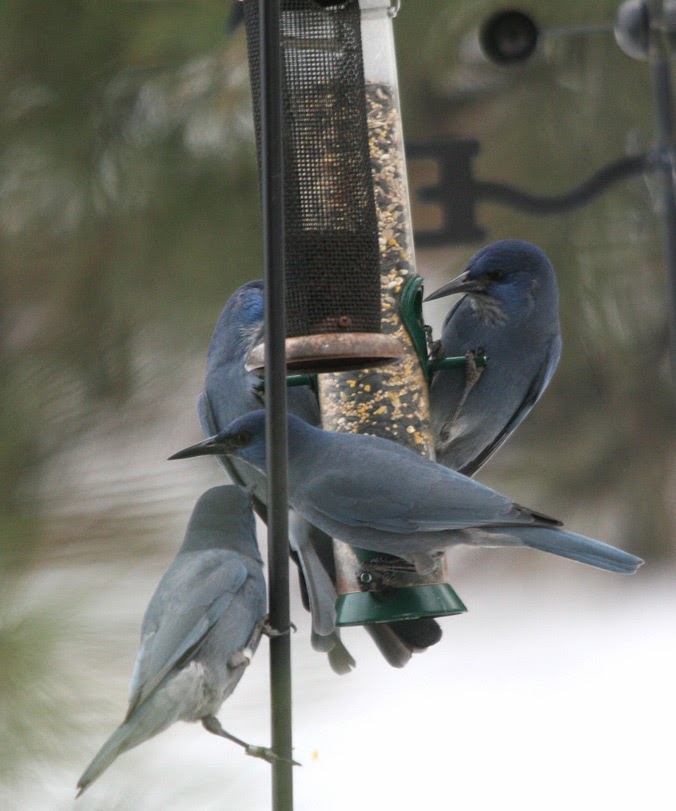
I was tired last night.  In addition to getting up before sunrise and then birding until about 11:00 am, I drove at least 3.5 hours from Whitewater Draw south of Wilcox to Sky Harbor Airport in Phoenix, AZ.  After about an hour to exchange rental cars, I drove 2.5 hours from Phoenix to Flagstaff to stay the night.  There was a marked temperature change between SE Arizona and Flagstaff.  There were piles of snow in Flagstaff and a few icy patches on the streets, and of course it was quite a colder with temperatures in the high 20’s to low 30’s.  Fortunately, I still had my warm clothing with me from my early December visit to Alaska including Nome! 

In the morning, December 19, when I got up it was already past sunrise.  I picked up breakfast to go at about 9:00 am on my way to Old Walnut Canyon Road.  Fortunately for me, Richard Fray posted to Arizona Birds and gave more information about where his group had found Pinyon Jays on Old Walnut Canyon Road.  He found eight Pinyon Jays about a mile southeast of the ponds.  I found my way to Old Walnut Canyon Road rather easily with Google Maps, and it was not very far from where I picked up breakfast.  The road was paved as it went through a development and the ponds were not very far.  The road turned to dirt/gravel after the ponds, but at least the road had winter maintenance.  There were houses and small ranches on the right side (south) back off the road with a hill sloping down to the road with ponderosa pines on the north side.  I stopped at the one mile point and birded for about 20 minutes without any success.  I did not find any Pinyon Jays.  There were no Pinyon Pines visible to me in this area, and I surmised that the Pinyon Jays may have been fly-bys.  I drove slowly about another mile down the road until winter maintenance ended, turned around and parked.  I started walking along the road looking for birds.  At first, I got excited by seeing jays, but they were all Steller’s Jays.  Then I noticed a man exiting a gated driveway down the road, and he appeared to be talking a walk.  I continued to walk in his direction, and when we met, he politely asked what I was doing.  I told him my story, which I had repeated many time this past year.  I introduced myself, told him I was from Cincinnati, Ohio, had retired from Procter and Gamble and was doing a Big Year trying to identify as many birds as possible within this calendar year.  Then it got really interesting.  He was originally from southern Kentucky, his family lived in northern Kentucky across the Ohio river from Cincinnati for a while before moving to Flagstaff, Arizona.  He knew areas of Cincinnati that I mentioned.  His name was J as in the southern practice of naming boys J Robert, etc.  He knew about Pinyon Jays and stated that they were a bit of a nuisance.  A large flock came to their feeders early in the morning, scared all the other birds away, gobbled up a lot if not all the food, and then did it again late afternoon or evening.  The Pinyon Jays had already been to their feeders earlier that morning.  He had taken a retirement package some years back, started a paint supply business, but has retired from that to restoring Aston Martin cars.  His wife was the birder in the family.  As we were talking, I would glance at a jay flying by and look at it through binoculars, but he would tell me, “That’s not a Pinyon Jay.  It’s flying like a Steller’s Jay.”  When I asked him how he knew, he described the swooping flight with a lot of sailing of the Steller’s Jay and the very direct flight of the Pinyon Jay.  When I told him that this was the one bird I was looking for today and would stay in the area, he suggested that we exchange cell phone numbers, which  we did.  If the Pinyon Jays returned during the day, which they might do, he would call me.  When I asked him if he knew where they went after they left the feeders, he told me that they fly north across the road from his house up the hill and apparently spend time on the mesa.   He gave me directions to the spot up the road toward the entry to get on the trails for the mesa.  If I did not see Pinyon Jays during the day, I could come back and see them come to the feeders in the late afternoon or early evening.  We parted ways.  How lucky can I get?  This seemed like my best chance to see Pinyon Jays, which can be difficult to find at times.  They travel around in flocks in the winter and do not necessarily stay in one place.   
I drove back toward the entry of Old Walnut Canyon Road and found the parking lot to the entrance to the trails for the Campbell Mesa on the north side of the road.  I found a PDF version of a trail map on the internet and downloaded it to my Droid Razr in order to have a trail map with me just in case I got lost.  I bundled up and started hiking the west loop.  I found Pygmy Nuthatch, Northern (Red-shafted) Flicker, Acorn Woodpecker, Dark-eyed Junco and Red-tailed Hawk but no Pinyon Jays.  I hiked for about an hour, stopping to bird on the way.  I hiked almost a mile mostly on a thin layer of snow and slippery mud at times.  However, I noticed that there were no Pinyon Pines and only a few juniper trees with no berries.  Both of these trees provide food for Pinyon Jay, particularly Pinyon Pines.  It seemed unlikely that I would find the Pinyon Jays here, and it was getting close to noon.  I decided to quit hiking the mesa, returned to my car and took one last drive down the road again before heading out to get some lunch.  Not far from J’s house, I was out of the car scanning and happened to look up and see an adult Bald Eagle fly over.  J had told me about a Bald Eagle in the area, and Richard Fray had reported two near the ponds.  There was also a continuing Red-tailed Hawk in the area that I had seen earlier.  Then, I headed back toward Flagstaff to get some lunch.
While I was picking up my grilled chicken salad for lunch, J called me.   His wife was putting out more seed and water to attract the Pinyon Jays.  I was welcome to come to their house and park in the driveway to watch for the Pinyon Jays.  He would prop open the gate.  I said I would be there in about a half hour. 

I arrived at about 2:00 pm and pulled into the driveway to park near where J’s wife had spread seed on the driveway and where I had a clear view of the feeders.  Steller’s  Jays had already found the bounty as well as Dark-eyed Juncos (Gray-headed and Oregon races).  See photos.
Steller's Jay

Steller's Jays
white on forehead and above eye indicates southern Rockies  race


Dark-eyed Junco (Gray-headed)


Dark-eyed Junco (Oregon)
While I waited, J had stopped to visit on his way to and from his shop and house.  After I saw the Pinyon Jays, he invited me to visit his shop, to see his restored Aston Martin cars.  I also met his wife on her way out to a doctor’s appointment.  An Acorn Woodpecker and then a Downy Woodpecker also came in.  Suddenly, all the birds scattered and an immature Sharp-shinned Hawk landed in an apple tree right in front of my car.  I was staring eye-to-eye into the fierce eyes of a sharpie.  However, the hawk did not stay very long and did not catch any prey.  Gradually, the Steeler’s Jays returned first followed by the juncos and then the woodpeckers.  I kept watching and hoping for the Pinyon Jays to visit, scanning the distant trees behind the house for evidence of Pinyon Jays.
At 3:45 to 4:00 pm, I saw a flock of jay-sized birds with very direct flight fly out of the woods to the south behind the house.  It was the Pinyon Jays!  A flock of 30 to 40 birds came in landing in the apple tree and on the driveway, scattering the Steller’s Jays and juncos.  I started taking photos.  See below.

Pinyon Jays
Arrive with a flurry

Pinyon Jays
Taking over the feeders
Pinyon Jays
Dominating the spread seed
The Pinyon Jay show did not last very long just as J had told me.  They were near the feeders for at most twenty minutes.  After my last photo at about 4:20 pm, I walked over to J’s shop to thank him, tell him of my success and see his autos.  When J asked me if I was successful, I showed him my photos, and his response was ‘Well, I guess so!”  I thanked him for his help.  His son was there and also stated that the Pinyon Jays were a nuisance.  J showed me his cars, which he restored as a hobby.  However, he had decided to sell a station wagon model with wood trim on the outside to a man in Connecticut.  Soon, it was time to leave.  I was planning to drive to Albuquerque to try for rosy-finches in the morning.  J cautioned me about snow headed to Flagstaff and suggested that I might want to stop halfway for a motel if I got tired.  I had noticed the cloud cover moving in after a very clear morning and early afternoon and had checked the local weather.   I thanked him again for everything and was on my way toward NM, leaving the Flagstaff area at about 4:50 pm, after buying gas, some food and hot chocolate.  I easily outdistanced the approaching snow and arrived in Albuquerque, NM before 10 pm.  I checked into a motel and got something to eat.  Tomorrow, December 20, I will go to Sandia Crest to try to see Black and Brown-capped Rosy-Finches.  In addition, there have been large flocks of Chestnut-collared Longspurs reported in some grassland about one hour south of Albuquerque.   I am hoping that I will have better luck finding Chestnut-collared Longspurs further north than in southeast Arizona due to the relatively mild winter conditions so far. 
Pinyon Jay raises the total to 724 plus three provisional, White-cheeked Pintail, Common Redstart and Eurasian Sparrowhawk as of December 19.   (See the final total for the year, 733 + 2 provisionals, reported on January 3, 2014.)            


Wednesday, February 26, 2014

Whitewater Draw, December 18

I left my motel before first light, picked up a carry out breakfast and headed toward Whitewater Draw, about an hour drive from Wilcox and roughly 60 miles.  On the way I experienced a beautiful Arizona sunrise.  See photo.
Sunrise at 7:00 am

As I got closer to Whitewater Draw, I saw large flocks of Sandhill Cranes flying out to the fields to feed.  Later in the morning, I would see them returning to Whitewater Draw.  I arrived at Whitewater Draw at about 7:45 am when the sun was fully up and bright.  I stopped at the restrooms and also signed the visitor log.  There was a camper parked near the restroom, but all was quiet.  This was the first time that I have visited Whitewater Draw; therefore, I checked the maps to make sure I headed in the correct direction to the location where the Ruddy Ground-Doves had been seen.  The most recent sighting that I knew of was December 13, only five days ago, “near the “T” junction of the west dike and the north dike which circles the pond where the pump is located.”  I drove to the big parking area beyond the restroom near the trail head, parked, got my gear together and walked west on the trail, which should lead to the west dike according to the posted maps near the trailhead.  There were no other birders present.  It was a short walk to a “T” intersection with a nearby picnic table.  The Ruddy Ground-Doves had been seen near this picnic table by one observer.  There were no birds there.  I walked a short distance further west to be sure that this was the “T” intersection I was looking for and found that this west dike ended in water.  Satisfied that this intersection was the correct “T” intersection, I started walking slowly north on the trail toward a curve and tall grasses on either side of the trail.  Soon, I saw small doves on the ground feeding with a few sparrows.  There were about five small doves, and at least one looked like a Ruddy Ground-Dove with a gray bill without pink at the base and no scaling on the breast or back of the head and with linear dark marks in scapulars.  I started taking photos and followed the doves around the corner until the tall grasses turned into lower vegetation.  At that point, most of the doves, seven or eight in total, flew back toward the “T” intersection.  However, I got a good look at one Common Ground-Doves with the pink base to the bill and scaling on the breast and head. I found a female and an apparent male Ruddy-Ground Dove, which is consistent with the two Ruddy Ground-Doves reported previously at this location.  I suspect that there were at least five or six Common Ground-Doves, but did not get an accurate count.  See photos below for identification field marks verifying Ruddy Ground-Doves and a few photos comparing the apparent male Ruddy Ground-Dove with a Common Ground-Dove.
Ruddy Ground Dove
gray bill, no pink at base, no scaling on breast and head
linear marks in scapulars, male (?) on left-more reddish
female on right-grayer

Common Ground-Dove (for comparison)
pink at base of bill, scaling on breast and head
lacks dark linear marks in scapulars
Ruddy Ground-Dove, left, apparent male
Common Ground-Dove-right

It was still early, before 9:00 am.  I started walking back to my rental car.  There were not many birds to see, and nothing new for the year at the draw.  I saw a small flock of Cinnamon Teal, a few scattered Mallards, White-crowned and Swamp Sparrows and a few Mourning Doves.  There was a Vermillion Flycatcher not far from the parking area.  When I got back to the restroom, I met the man in the camper.  He was originally form Washington or Oregon and was travelling around the southwest.  He had tried unsuccessfully to photograph the Vermillion Flycatcher.  He told me about a Barn Owl in the nearby hay barn, which was open on all four sides with a roof.  We went over to see if the Barn Owl was there, and yes, it was.  See photo.
Barn Owl in hay barn
As we were talking some of the Sandhill Cranes were returning to the draw in small flocks.  See photos. 
Sandhill Cranes returning to Whitewater Draw

 
Sandhill Cranes returning
I left Whitewater Draw before 10:00 am, and decided to check some of the farm fields for flocks of Horned Larks and longspurs.  I was particularly hoping for Chestnut-collared Longspur.  On the way out of Whitewater Draw along Davis Road I found a cooperative Ferruginous Hawk.  See photo.
Ferruginous Hawk
note extended gape under the eye

I stopped at four or five likely looking fields for Horned Larks and longspurs using my outdated bird finding guides, Finding Birds in Southeast Arizona, Davis and Russell, Tuscon Audubon Society and A Birder’s Guide to Southeastern Arizona, ABA, Richard C Taylor.  Many of the sites indicated were still likely looking locations for Horned Larks and longspurs.  However, I didn’t find one Horned Lark and no longspurs is this area.  I suspected at the time that I was a little early to find these birds, and they may still be further north.  Yesterday, Jackie Lewis in Paradise had told me that it had been a mild winter so far, suggesting that I might be correct.  In addition, just before writing these updating blog posts, I checked eBird and found that there were many reports of Chestnut-collared Longspurs at San Rafael Grasslands starting on December 29 and continuing through January.  Just two days ago, I didn’t find a single horned Lark or longspur at the grasslands!
I needed to exchange my rental car for a new one in Phoenix, because the oil was due to be changed.  Therefore, I headed back to I-10 and drove to Phoenix.  Then I drove to Flagstaff to try for Pinyon Jay.  When I met Richard Fray at Florida Canyon several days ago, he told me that his group had found Pinyon Jays near Flagstaff on Old Walnut Canyon Road.  I stayed the night of December 18 in Flagstaff, AZ in order to try for Pinyon Jay, tomorrow, December 19.

Ruddy Ground-Dove raises the total to 723 + 3 provisionals, White-cheeked Pintail, Common Redstart and Eurasian Sparrowhawk as of December 17.  (See the final total for the year, 733 + 2 provisionals, reported on January 3, 2014.)